

Fruit and vegetable nori is a commercial composite food product made by sandwiching dehydrated fruit powders, vegetable purees, or seeds between two sheets of roasted Porphyra seaweed. It is used primarily by CPG (Consumer Packaged Goods) brands as a ready-to-eat, high-margin functional snack that offers a low-calorie, high-fiber alternative to traditional extruded products. For B2B procurement teams, understanding the exact material composition and factory processing parameters is essential before initiating any large-volume OEM contract.
This product directly targets the healthy snacking sector. The manufacturing process requires specialized automation to prevent the delicate seaweed from absorbing moisture from the filling. Buyers must evaluate supplier capabilities, focusing heavily on moisture control and regional import compliance.
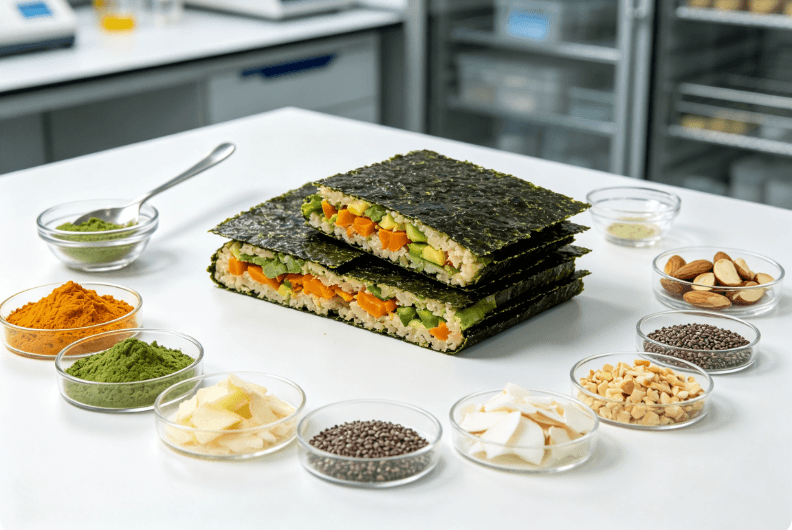
Technical Anatomy of Sandwich Nori Formulations
Creating a stable, double-layered seaweed snack requires precise biochemical formulation. The binding liquid must adhere the ingredients without elevating the internal water activity (Aw) of the final product.
Factories frequently utilize trehalose or maltitol syrup as binding agents. These low-sugar carbohydrates hold freeze-dried pumpkin, coconut chips, or apple powders in place without introducing excess liquid. Maintaining a strictly low moisture content ensures the final cut pieces do not snap or shatter during transit.
The core seaweed must meet strict commercial grade standards. High-grade Porphyra is harvested, mechanically dried, and rigorously sorted before entering a snack line. Lower commercial grades lack structural integrity and easily tear when the automated nozzles dispense the binding syrup.
The Automated OEM Manufacturing Workflow
Reliable production dictates the final product quality and commercial shelf life. Understanding how commercial nori is made reveals why environmental temperature control is the most critical parameter in modern production facilities.
- Material Sorting and Dehumidification:
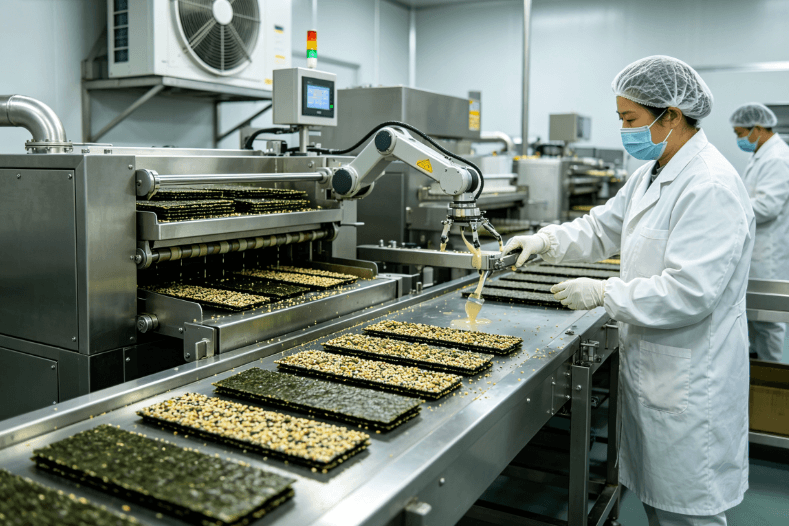
Workers inspect dried nori sheets for structural uniformity. The approved seaweed passes through a specialized dehumidification unit to remove ambient moisture, ensuring a crisp base layer. - Automated Coating and Filling:
Precision nozzles dispense a microscopic layer of edible binder. The specified fruit, vegetable, or seed mix is scattered uniformly across the sheet before a second nori sheet caps the assembly. - Continuous Tunnel Roasting:
The sandwiched raw material enters a multi-zone tunnel oven. Precise thermal regulation prevents the fruit sugars from scorching while locking in the signature crisp texture of the seaweed. - Laser Cutting and Sealing:
Automated blades slice the large sheets into specific retail dimensions. The snacks drop immediately into nitrogen-flushed primary packaging to halt lipid oxidation and block humidity.
Retail Applications in the North American Market
Food brands utilize this product architecture to target several distinct commercial demographics. Identifying your specific end-user dictates the precise OEM filling ratio you should request.
Infant and Toddler Snacking Segments
Parents actively seek clean-label products with zero artificial additives. Vegetable-infused seaweed provides extremely high nutritional density in a dissolvable format. Formulations utilizing organic sweet potato or spinach powders perform exceptionally well in North American grocery chains.
Adult Functional and Keto Foods
Fitness-conscious consumers look for snacks fortified with plant-based protein. Integrating almonds, chia seeds, or dried berries elevates the perceived retail value. These products are often merchandised as premium office snacks in natural food stores.
Supplier Evaluation and US Import Compliance
Selecting the right overseas manufacturing partner mitigates severe supply chain disruptions. For buyers importing through major West Coast hubs like the Ports of Los Angeles or Long Beach, strict regulatory compliance is non-negotiable.
Suppliers must hold current FDA facility registrations under the Food Safety Modernization Act (FSMA). Facilities should also provide documentation demonstrating adherence to HACCP or ISO 22000 standards. Without these baseline certifications, containers face high risks of customs detainment.
California-based buyers must also account for Proposition 65 compliance. Seaweed naturally accumulates trace oceanic minerals, including heavy metals like cadmium and lead. Reputable factories provide routine third-party laboratory testing to verify that their raw materials fall well below strict California legal thresholds.
When expanding retail product lines, procurement teams often evaluate specialized catalogs of fruit and vegetable nori to identify scalable flavor combinations. Reviewing an existing manufacturer’s portfolio accelerates the initial R&D phase and reduces custom sampling lead times.
Cost Drivers in Wholesale Procurement
Pricing for private label seaweed snacks fluctuates based on several core manufacturing inputs. The grade of the raw nori sheet serves as the primary cost baseline. Grade A seaweed commands a significant premium due to its uniform dark green color and superior structural strength.
Filling ingredients heavily impact the final wholesale unit price. Pure freeze-dried fruit powders cost substantially more than standard roasted sesame seeds. Custom binding syrups formulated strictly without artificial sweeteners also increase batch production overhead.
Packaging complexity adds another layer to the overall landed cost. Custom-printed, matte-finish stand-up pouches require upfront cylinder fees and higher minimum order quantities. Standard pillow packs utilizing continuous film rolls offer a much more cost-effective solution for budget-conscious brands.
Packaging Engineering for Hygroscopic Stability
Packaging engineering is just as critical as the food formulation itself. Roasted seaweed is highly hygroscopic; it rapidly degrades and loses its crispness when exposed to even minor humidity.
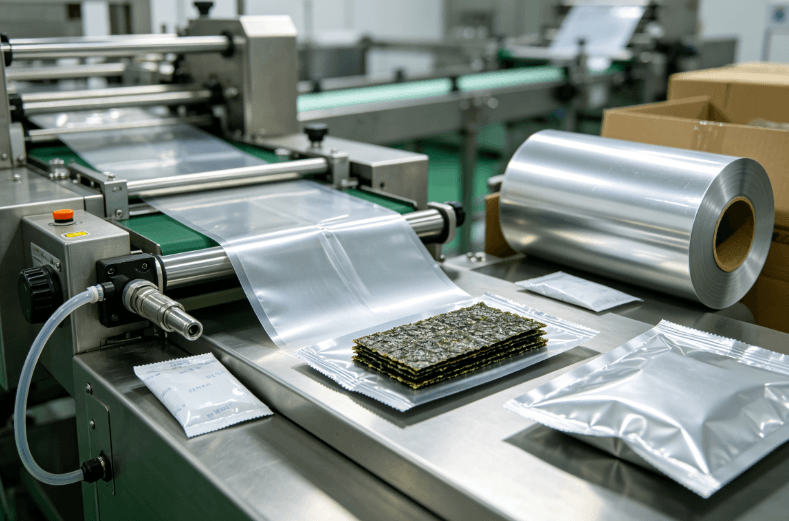
Retail items require specialized high-barrier packaging structures. Metallized PET films or aluminum foil laminates provide excellent moisture and oxygen barriers. Stand-up pouches fitted with resealable zippers enhance long-term consumer convenience after the initial opening.
Factories flush the packaging machinery with food-grade nitrogen gas prior to heat sealing. This displaces ambient oxygen, preventing the nut-based fillings from turning rancid. Silica desiccant packets are uniformly inserted into every pouch to absorb residual moisture during transpacific maritime shipping.
FAQ
What is the minimum order quantity (MOQ) for OEM fruit and vegetable nori?
MOQs typically range from 50,000 to 100,000 retail bags per SKU. This is largely driven by the printing minimums required for the custom high-barrier packaging film rather than the food product itself.
How do suppliers ensure Prop 65 compliance for US imports?
Tier-one manufacturers conduct rigorous incoming material inspections. They partner with certified third-party laboratories (like SGS or Intertek) to test every batch of raw seaweed for cadmium, lead, and arsenic before production begins.
What causes layer separation in sandwich nori?
Layer separation occurs if the binding syrup is applied too thinly or if the internal filling particle size is too large. Improper moisture balancing during the tunnel roasting phase can also cause the two seaweed layers to detach.
What are the standard lead times for West Coast ocean freight?
After finalizing the custom formulation and printing the packaging film, initial OEM production takes roughly 25 to 35 days. Ocean transit to the Port of Los Angeles adds another 15 to 25 days, depending on seasonal port congestion.
Can factories formulate zero-sugar binding agents?
Yes. Advanced facilities can utilize sugar alcohols like erythritol or specialized soluble corn fibers to adhere the layers. These formulations cater specifically to the low-carb and diabetic-friendly retail markets.
Reference Sources
- Haipu Food Official Platform. “Fruit & Vegetable Nori”. Retrieved from haipusushinori.com
- Haipu Food Official Platform. “What is Nori Food & How Commercial Nori is Made”. Retrieved from haipusushinori.com
- FDA Food Safety Modernization Act (FSMA) – Preventive Controls for Human Food. (U.S. Food and Drug Administration).
- OEHHA California Office of Environmental Health Hazard Assessment. “Proposition 65 Warnings: Heavy Metals in Food”.
- ISO 22000:2018 – Food safety management systems. (International Organization for Standardization).
- Eureka Patsnap. “Preparation method of low-sugar sandwich nori”. Patent Publication, March 2022.