

Shredded nori, also called kizami nori, adds umami, visual contrast, and fast application value to commercial foods. Shredded seaweed applications include prepared meals, ramen toppings, seasoning blends, snacks, bakery products, and food-service menus.
For industrial buyers, the product is more than a garnish. Cut uniformity, moisture stability, packaging format, and traceability affect dosing accuracy, shelf life, line efficiency, and finished-product consistency. The correct specification for shredded seaweed applications depends on the recipe, filling equipment, storage conditions, and expected consumption rate.
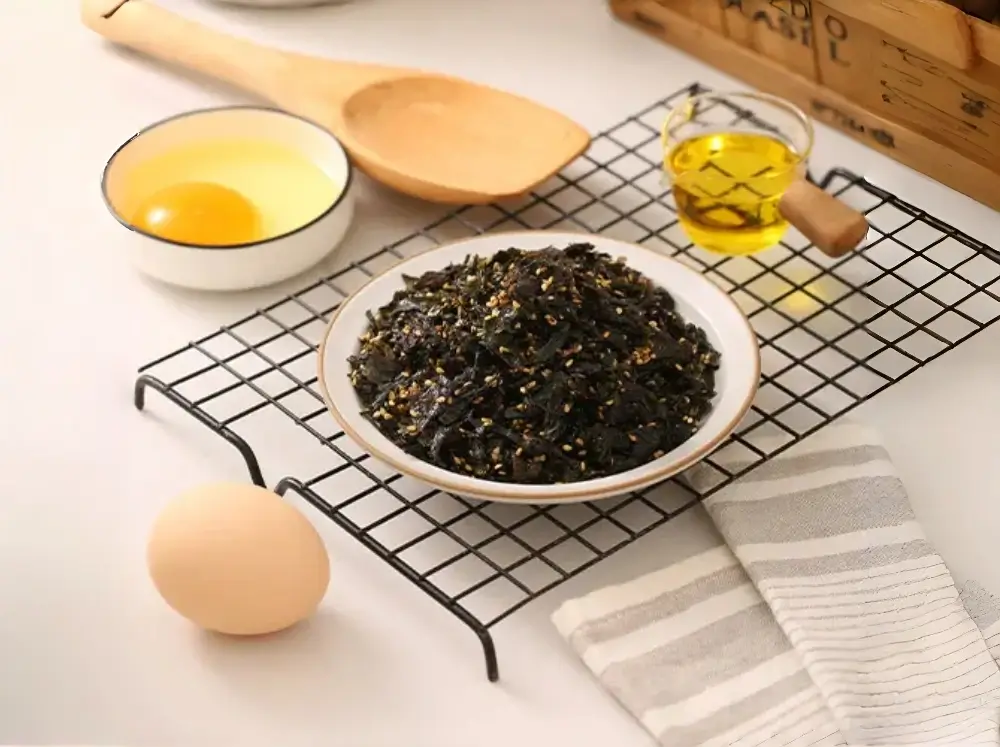
What Are Shredded Seaweed Applications in Food Manufacturing?
Shredded seaweed applications describe the commercial uses of sliced or finely cut roasted nori in manufactured foods and food-service operations. Kizami nori can be applied directly, mixed into seasoning systems, or packed as a separate topping sachet.
In commercial food manufacturing, the base seaweed must match the application. A stronger substrate can better withstand conveying, dosing, and mixing.
Why Cut Width Matters
Cut width influences appearance, texture, dispersion, and equipment compatibility. A narrow cut creates a fine topping, while a wider shred provides a more visible bite and stronger visual identity.
Typical commercial options include:
•1 mm: Fine garnish, seasoning blends, snack coatings, and small sachets.
•2 mm: A versatile option for ramen, rice bowls, salads, and prepared meals.
•3 mm: More visible texture for bakery toppings, premium bowls, and food-service presentation.
These ranges are starting points rather than universal standards. Buyers should validate the cut with their dosing system, product moisture, and target serving size.
Industrial Shredded Nori Applications Across Food Sectors
The most practical shredded seaweed applications improve production speed and eating consistency. The following table links common sectors with starting specifications for shredded seaweed applications.
| Manufacturing Sector | Specific Application | Recommended Cut Width | Packaging Type |
| Ready-to-eat meals | Ramen, seafood rice bowls, chilled noodles, onigiri | 2–3 mm | Food-service bags or bulk cartons |
| Snack manufacturing | Seasoned snack blends, nuts, crackers, extruded snacks | 1–2 mm | Vacuum bags inside moisture-barrier cartons |
| Seasoning production | Composite seasoning packs and furikake-style blends | 1 mm | Aluminum-foil vacuum bags |
| Bakery and savory dough | Seaweed bread, buns, crackers, savory pastries | 2–3 mm | Moisture-barrier bulk bags |
| Food-service supply | Sushi stations, salad bars, noodle chains, meal assembly | 2 mm | Resealable food-service packs or cartons |
| Topping sachets | Instant noodles, meal kits, and prepared-food accessories | 1–2 mm | Inner bags or pre-portioned sachets |
Ready-to-Eat Meals and Prepared Foods
Ramen, seafood rice bowls, chilled noodles, and rice balls often require a topping that can be dispensed quickly. Shredded nori provides a consistent garnish without requiring operators to cut sheets during assembly.
For central kitchens, 2 mm or 3 mm cuts commonly support visible shredded seaweed applications and practical handling. The final choice for shredded seaweed applications should consider whether the product is added before sealing, after reheating, or in a separate accessory pack.
In high-volume meal production, packaging is as important as the ingredient. A stable inner bag reduces exposure during repeated opening, while carton packing supports warehouse handling and batch identification.
Snacks and Seasoning Manufacturing
Snack producers use shredded nori in nuts, crackers, rice snacks, and compound seasoning systems. A fine cut can improve dispersion through a ribbon blender or seasoning drum.
The formulation team should check oil, salt, and carrier interactions. These ingredients can change adhesion, clumping, and perceived flavor intensity.
Bakery and Fusion Foods
Savory breads, buns, crackers, sandwiches, and fusion snacks create growing opportunities for shredded nori. Wider shreds can provide a clear seaweed identity on the surface or inside the dough.
These shredded seaweed applications need careful process testing. Steam, heat, fat, and dough moisture may soften the nori or reduce its visual contrast. For this reason, manufacturers may apply the product after baking, use a separate topping, or select a stronger roasted base.
Industrial Specifications: Cutting, Moisture, and Packaging
Precision cutting is central to reliable shredded seaweed applications in automated plants. High-speed cutting equipment should produce stable widths and lengths with limited fines, because excessive powder can affect dosing, appearance, and line cleanliness.
At Lianyungang Haipu Food Co., Ltd., automated production resources include high-speed precision slitting lines and optical grading processes. These systems are intended to support uniform shreds and reduce irregular fragments in bulk orders.
A technical specification should normally address:
•Target cut width, tolerance, and acceptable length range.
•Nori substrate strength and roasting profile.
•Color range, flavor profile, and visible defect limits.
•Fine-particle or powder control after cutting.
•Moisture target and test method.
•Inner-bag material, carton size, and pallet configuration.
Moisture Control and Industrial Packaging
Moisture is a major risk for roasted seaweed applications. Absorption can reduce crispness, increase clumping, and change the product’s behavior in automated dosing systems.
For many roasted nori products, a practical internal target may fall below 3–5%, subject to product type, test method, and customer specification. Buyers should confirm the agreed limit through a product specification and certificate of analysis rather than relying on a general number.
Common bulk formats include food-grade aluminum-foil vacuum bags placed inside protective cartons. This structure helps limit moisture and light exposure during transport and warehouse storage.
Packaging decisions should reflect actual production use:
•Use smaller inner packs when a line opens product gradually.
•Use bulk cartons when the factory has controlled, high-throughput consumption.
•Specify lot coding on both inner and outer packaging.
•Confirm storage temperature, humidity, and resealing procedures.
Bulk Sourcing and Custom Factory Solutions
Sourcing shredded nori bulk for food manufacturing requires more than comparing price per kilogram of shredded seaweed applications. Buyers should evaluate usable yield, powder loss, opening frequency, logistics, and the cost of line adjustments.
A qualified kizami nori supplier for food service or manufacturing should be able to discuss application requirements before quoting. The technical conversation should include the finished food, production speed, topping method, expected annual volume, and destination-market rules.
Lianyungang Haipu Food Co., Ltd. operates a 20,000-plus-square-meter production base in Lianyungang, a major seaweed-processing area in China. The company reports more than 100 automated production machines, including high-speed precision cutting equipment.
Its product range supports shredded seaweed applications through shredded nori, seasoned nori for rice, sushi nori, and sandwich nori. The Puno Tai and HaddieBear brands serve branded channels, while factory supply can be discussed for bulk and private-label requirements.
For international buyers, export readiness should be verified for each order and destination. Haipu Food states that its quality and compliance system includes ISO 9001, HACCP, Halal, SGS-related inspection services, and export food manufacturer registration.
Quality Control, Traceability, and Buyer Verification
Food manufacturers need documentation that supports supplier approval and audits for shredded seaweed applications. Shredded seaweed applications should be evaluated through a risk-based quality process, not only through visual inspection.
Typical controls may include:
•Incoming raw-material checks and supplier-lot identification.
•Roasting and cutting process records.
•Moisture testing during production and release.
•Metal detection and, where specified, X-ray foreign-object screening.
•Seal-integrity and packaging checks.
•Retained samples linked to production batches.
•Certificate of analysis review before shipment.
A buyer should request a current specification sheet, COA format, allergen statement, microbiological requirements, shelf-life basis, and destination-market documentation. If FDA-related compliance is required, the importer and supplier should confirm the applicable U.S. food, labeling, registration, and facility requirements for the specific product.
The same principle applies to Halal or other market claims. Certification scope, certificate validity, product coverage, and labeling permissions should be checked before commercial launch.
FAQ for Industrial Buyers
What is the typical MOQ for industrial shredded nori?
MOQ depends on cut width, substrate, packaging, seasonings, private-label needs, and destination. Standard bulk products usually offer a more efficient starting point than highly customized formats. Request a quotation based on annual volume and shipment frequency.
Can a factory customize shredded nori cut sizes?
Yes, cut width and packaging can often be customized after technical review. Common starting points are 1 mm, 2 mm, and 3 mm. Buyers should approve a physical sample and test it on their own dosing or mixing line.
What is the shelf life of bulk shredded nori?
Shelf life varies with roasting level, moisture target, packaging barrier, storage conditions, and local regulations. The supplier should state the validated shelf life on the specification or COA documentation. Keep unopened packs sealed, dry, cool, and protected from direct light.
Can the supplier provide a COA report?
A commercial supplier should be able to provide a COA or agreed batch-quality document covering relevant parameters. Confirm whether it includes moisture, microbiological results, foreign-object controls, lot information, and any destination-market requirements.
Industry Quality & Compliance Standards Cited
•HACCP: Hazard analysis and critical control planning for food safety risks.
•ISO 9001: Quality-management system framework supporting documented processes and continual improvement.
•Halal: Certification requirements for applicable ingredients, processing, and handling claims.
•SGS: Independent inspection, testing, or certification services when specified by the buyer or market.
•FDA requirements: U.S. food-safety, labeling, facility, and import requirements that may apply to the product and importer.
•Export Food Manufacturer Registration: Documentation supporting export eligibility in relevant markets.
For manufacturers assessing shredded seaweed applications, the best supplier decision balances flavor, cut performance, moisture control, documentation, and supply reliability. A technically matched specification can help shredded nori run consistently from factory line to finished product.