

What is sandwich nori? Sandwich nori refers to premium-grade roasted seaweed specifically processed to possess higher tensile strength and moisture resistance. This unique structural profile makes it ideal for folding into rice sandwiches, commonly known as onigirazu, or acting as an edible wrap.
Unlike thin, brittle snack seaweed, structural wrap nori must withstand the moisture of warm rice and heavy fillings without tearing. In commercial manufacturing, the term can also refer to laminated seaweed snacks. However, in culinary applications, it denotes a highly flexible, durable wrap designed for heavy-duty food assembly.
For food service operators and wholesale buyers, understanding the structural mechanics of roasted seaweed is critical. Selecting the wrong grade results in product failure, poor presentation, and degraded texture. This guide breaks down the science and application of using seaweed for wraps.
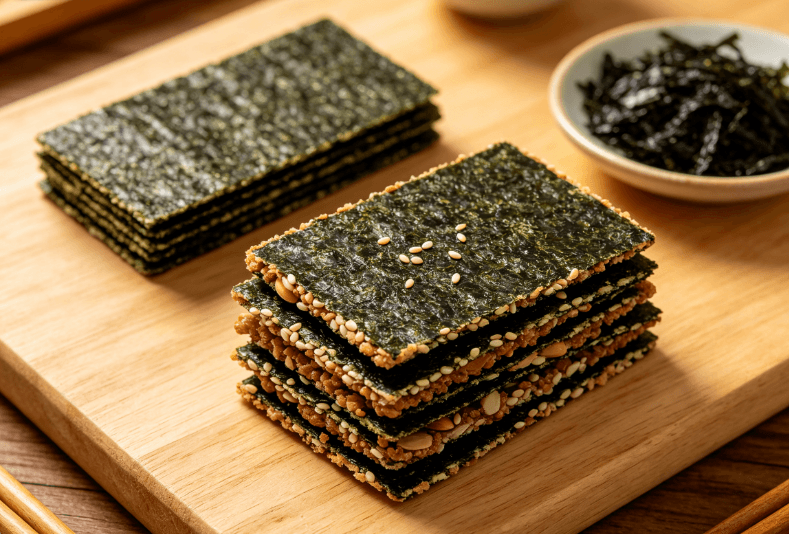
What Is Sandwich Nori: The Dual Industry Definition
In the commercial seaweed manufacturing sector, this term frequently describes two entirely different product categories. Understanding this distinction is vital for accurate procurement and application.
First, culinary sandwich nori serves as a functional wrap for onigirazu. It is a full-sized sheet of yaki nori (roasted seaweed) chosen specifically for its high fiber density. The material must easily fold around wet ingredients without immediate disintegration.
Second, the term describes laminated sandwich nori snacks. These are ready-to-eat OEM commercial products where two thin layers of seaweed are bonded together using maltose syrup. The core is typically filled with sesame seeds, almonds, or brown rice crisps.
Here is a quick breakdown of their differences:
| Feature | Laminated Snack Nori | Structural Wrap Nori |
| Application | Ready-to-eat consumer snack | Edible casing for onigirazu/wraps |
| Processing | Laminated, baked with syrup | Single layer, precision roasted |
| Flexibility | Zero (brittle and crispy) | High (pliable when hydrated) |
| Moisture Tolerance | Low (gets sticky) | High (absorbs steam evenly) |
Material Mechanics: Why Standard Nori Fails in Wraps
Using cheap or low-grade seaweed for wraps usually ends in structural failure. The core issue lies in the material’s interaction with moisture and heat.
Seaweed sheets are manufactured by pressing and drying wet Porphyra algae. Lower grades contain micro-perforations and uneven fiber distribution. When warm rice is applied to these grades, the steam rapidly hydrates the hydrocolloids in the seaweed.
If the sheet is too thin, the steam penetrates immediately. This causes the wrap to melt, tear, or completely collapse. In commercial kitchens, this leads to significant food waste and unacceptable plating.
Premium grades feature a much tighter matrix. This high density slows moisture absorption dramatically. It allows the wrap to soften just enough to fold, without breaking apart under the weight of the interior fillings.
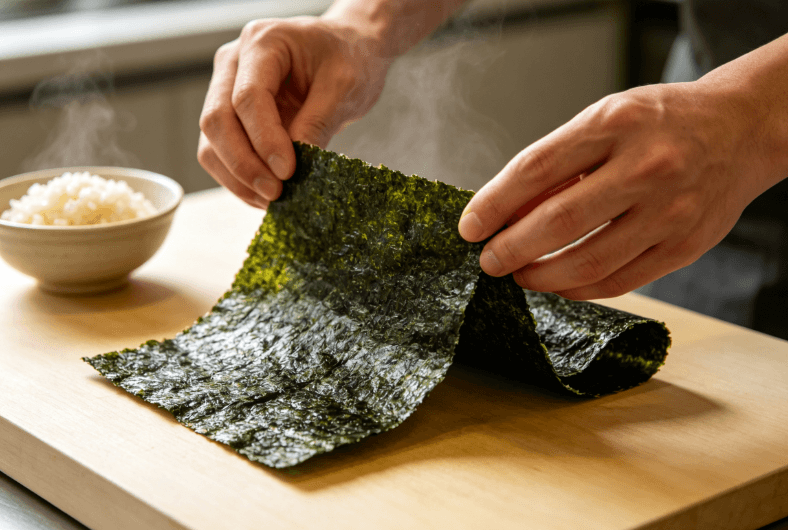
How to Use Nori for Sandwiches and Wraps
Constructing an onigirazu or a seaweed wrap requires precise assembly. The goal is to balance moisture transfer so the nori becomes pliable but never soggy.
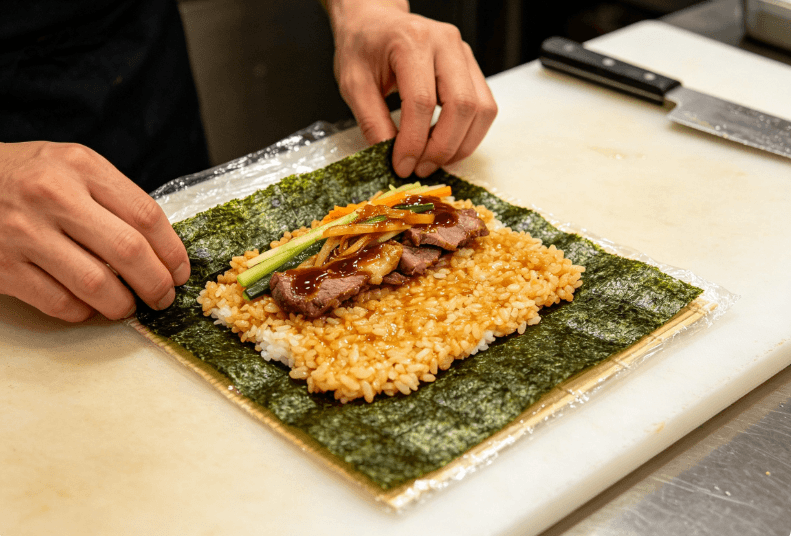
Follow this standard assembly workflow for optimal results:
- Base Positioning: Place a full sheet of high-grade roasted nori shiny-side down on a dry, flat surface.
- Moisture Barrier: Spread a measured, even square of warm seasoned rice in the exact center.
- Core Assembly: Layer your proteins, sauces, and vegetables directly on top of the rice.
- Top Anchor: Add a second thin layer of rice over the fillings to protect the upper seaweed fold.
- Folding Geometry: Fold the four corners of the nori inward toward the center, creating a tightly sealed envelope.
- Resting Phase: Wrap the entire sandwich tightly in food-grade plastic film.
- Hydration Dwell: Let it rest for exactly five minutes before handling further.
The resting phase is the most critical step. This allows ambient steam to soften the rigid fibers gently. Once rested, the sandwich can be sliced in half with a wet, sharp knife without the seaweed cracking.
Commercial Selection: Specifying the Right Seaweed Grade
For B2B buyers, OEM project managers, and restaurant chains, sourcing the correct material dictates product viability. Procurement teams must focus on specific manufacturing metrics rather than just price.
Grade Classification
Always specify Gold (Grade A) or Silver (Grade B) nori for wraps. These grades guarantee minimal dead spots and high structural integrity. They possess the necessary thickness and density to handle wet culinary environments.
Roasting Tolerances
The seaweed must be uniformly roasted. Industrial roasting temperatures typically range from 240°C to 280°C. Proper roasting ensures the cellular structure is dry enough to snap, yet capable of absorbing moisture evenly during meal assembly.
Moisture Content and Packaging
Quality sandwich nori must maintain a moisture content strictly below 4% before use. Bulk packaging must include high-barrier aluminum mylar bags equipped with industrial silica gel desiccants. Exposure to ambient kitchen humidity will ruin the tensile strength in minutes.
Evaluating Haipu Sushi Nori for Commercial Applications
Finding a reliable manufacturing partner is the final step in successful product execution. Manufacturer capacity directly influences material consistency, lead times, and application performance.
Platform pages like Haipu Sushi Nori’s Sandwich Nori category demonstrate dedicated processing lines for these specialized products. Haipu Sushi Nori provides highly calibrated roasted seaweed tailored for rigorous commercial demands.
Their facilities maintain strict environmental controls during production. This ensures the raw material retains its rich umami profile while achieving the exact structural flexibility required for demanding sandwich wraps. Procurement teams can evaluate their wholesale specifications to match specific operational and compliance requirements.
FAQ
What is the difference between sandwich nori and standard sushi nori?
Standard sushi nori is designed for rolling (maki) and comes in various grades. Sandwich nori specifically requires Gold or Silver grades with higher fiber density to handle the intense moisture and weight of an onigirazu wrap without tearing.
Why does my nori wrap tear when folding it?
Tearing occurs due to three main reasons: using a low-grade sheet with micro-perforations, applying rice that is far too hot, or failing to let the seaweed rest. The steam must slowly soften the fibers before cutting or aggressive handling.
Can I use laminated seaweed snacks as a wrap?
No. Laminated seaweed snacks are baked with syrups and filled with nuts or seeds to create a brittle, rigid texture. They lack the flexibility and structural integrity needed to encase wet ingredients and will shatter if folded.
How long does sandwich nori maintain its structure after assembly?
Once assembled and wrapped in plastic film, an onigirazu maintains optimal texture for 2 to 4 hours. After this period, the moisture from the rice will eventually over-hydrate the seaweed, causing it to become overly chewy or soggy.
Reference Sources
- ISO 22000: Food Safety Management Systems standards for commercial seaweed processing and packaging.
- FDA Guidelines for Dried Food Processing: Regulatory frameworks regarding moisture control (sub-4%) in dried edible algae products.
- Industry Technical Standards on Porphyra Yezoensis: Material science evaluations detailing the hydrocolloid properties and tensile strength of commercial yaki nori.