

When determining how to choose nori for commercial food manufacturing, procurement teams must evaluate tensile strength, moisture levels, and commercial grading to match specific processing machinery. High-speed sushi robots require Gold or Silver grades to prevent tearing under mechanical stress. Snack laminators can utilize Blue or Green grades for optimal seasoning absorption. Moisture content must remain strictly below 5% across all applications to prevent blade jamming during continuous factory processing.
Selecting seaweed for industrial production requires strict engineering and procurement logic. In large-volume operations, material consistency directly impacts the efficiency of automated packaging lines. Yield rates drop significantly if brittle sheets fracture during folding. Engineers and procurement managers must align on technical parameters before finalizing any supply contracts. This prevents costly factory downtime and limits product rejection rates.
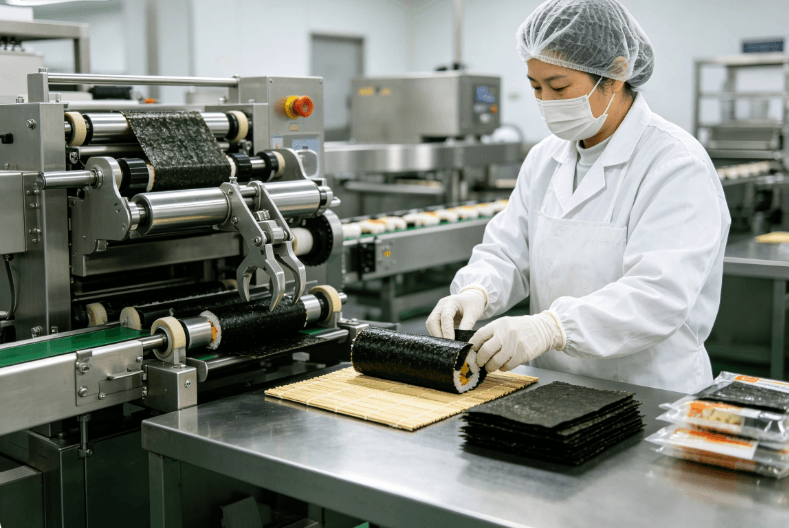
What Technical Specs Matter for High-Speed Processing?
Industrial food machinery demands uncompromising material reliability. Running automated maki-rolling equipment or continuous snack lines dictates strict operational tolerances. Factories cannot rely on taste testing alone.
- Moisture Tolerance: Standard Yaki Nori requires moisture levels below 5%. Higher moisture content immediately gums up automated cutting blades.
- Tensile Strength: Production sheets must withstand rapid mechanical folding. They cannot crack under tight rolling tension.
- Hole Defect Rate: Premium sheets lack micro-perforations. Dead spots allow warm rice moisture to leak through the wrap, destroying product shelf life.
- Dimensional Stability: The global industry standard for a full sheet is exactly 21x19cm. Processing machines are calibrated precisely to this dimension.
- Foreign Matter Control: Raw materials require optical sorting and metal detection. This removes microscopic oceanic debris prior to roasting.
The Commercial Nori Grading Scale Explained
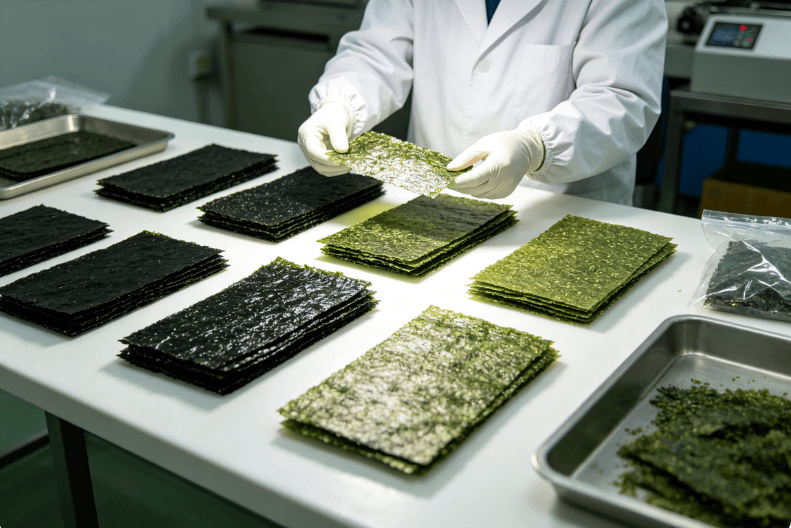
Global wholesale supply chains grade seaweed based on visual and structural metrics. Flavor is simply a natural byproduct of these physical attributes. Evaluating these grades requires controlled lighting to check for uniform light transmission across the surface.
| Grade Label | Color Profile | Physical Characteristics | Best Commercial Application |
| Gold (A) | Jet black, high gloss | Zero holes, uniform thickness | Premium restaurant sushi, Omakase |
| Silver (B) | Dark green-black | Minor structural variations | Retail sushi rolls, Onigiri production |
| Blue (C) | Solid flat green | Noticeable thin spots, brittle | Seasoned snacks, industrial hand rolls |
| Green (D) | Pale green, dull | Micro-holes, highly fragile | Processed garnishes, powder extraction |
Spotty light penetration indicates uneven spreading during the wet-mesh drying phase. This structural weakness later translates to mechanical failure on the factory floor.
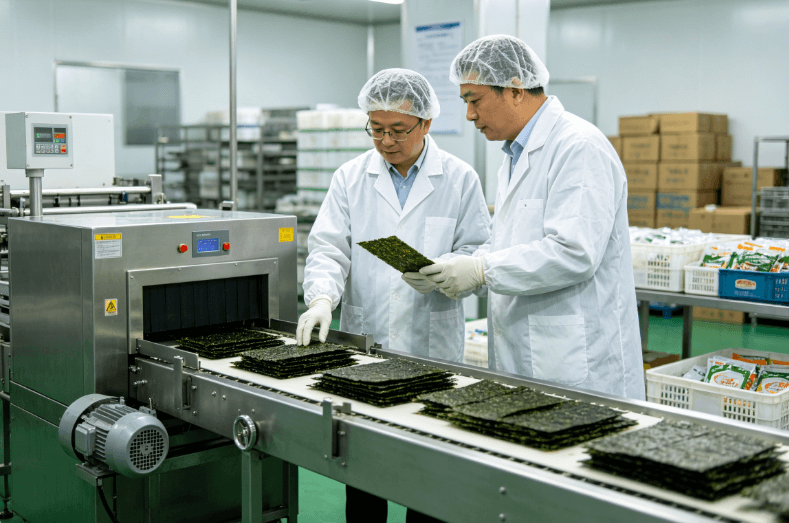
Matching Material to Manufacturing Applications
Different food processing categories require entirely distinct manufacturing specifications. Mis-specifying the material grade leads to massive production waste.
Sushi Chains and Onigiri Manufacturing
Automated maki-rolling machines require Gold or Silver grades. Lower grades tear instantly under robotic tension. The seaweed must resist immediate degradation when exposed to warm, acidified rice. For retail Onigiri packaging, factories utilize specialized double-layer moisture-barrier films. This keeps the seaweed completely separated from the rice until consumer activation.
Seasoned Snacks (Ajitsuke Nori)
Snack manufacturing relies heavily on a balance between crispness and liquid flavor adhesion. Blue or Green grades perform perfectly for this application. The slightly porous nature of lower grades allows seasoning liquids to penetrate deeply. The sheets then dry effectively during the secondary roasting phase without becoming excessively tough.
Kizami and Aonori Garnishes
For Kizami Nori (shredded seaweed), the cutting process requires extremely dry, brittle sheets. If the material retains even fractional moisture, the shredding blades will fail. Green grade sheets provide the exact fragility needed for high-speed industrial shredding.
Evaluating OEM Suppliers and RFQ Workflows
B2B purchasing requires a deep understanding of what drives the unit cost of seaweed. Buyers must structure their Request for Quotation (RFQ) based on realistic manufacturing constraints.
When configuring an RFQ, engineering teams often reference standard product specifications. For example, reviewing baseline sushi nori category options helps procurement verify exact sheet dimensions and commercial grade availability. This ensures the raw material matches the automated line calibration.
Top-tier suppliers invest heavily in optical laser sorting and X-ray inspection. These machines detect and remove microscopic shells, microplastics, and stray fishing nets. Proper supplier vetting prevents downstream manufacturing bottlenecks. Understanding how to choose a sushi nori supplier involves auditing their HACCP certifications, foreign matter detection systems, and export compliance records.
Heavy metal testing, iodine levels, and microbial load documentation are absolutely mandatory. Without these verified documents, cargo faces immediate rejection during customs clearance in western markets.
Real-World Procurement Constraints
Shifting from product specifications to procurement logistics requires strict vendor evaluation. Reliable B2B suppliers must demonstrate consistent quality systems and verified production scalability.
Production Capacity and MOQ
Unit costs decrease significantly as order volumes scale. Standard MOQs for custom-branded retail packaging usually start at 10,000 to 50,000 bags. This volume justifies the setup requirements of commercial flexographic printing presses. Conversely, bulk wholesale cartons for foodservice have much lower MOQ thresholds.
Harvest Timing Specifications
Seaweed harvested during the first winter flush commands the highest market price. It yields the most tender, visually striking sheets. Later harvests become progressively tougher and cheaper. Commercial buyers must specify harvest timing requirements in their initial RFQs to lock in desired quality tiers.
Frequently Asked Questions
Why does nori tear in automated sushi machines?
Automated sushi machines apply rapid mechanical stress during the folding and rolling phases. Sheets with low tensile strength or micro-holes fracture instantly under this tension. Operations utilizing robotics must specify Gold or Silver grade Yaki Nori to maintain necessary yield rates.
What is the standard MOQ for OEM seasoned nori snacks?
For custom-printed retail packaging, factories typically require an MOQ of 10,000 to 50,000 units. This volume justifies the high setup costs for flexographic film printing and continuous line extrusion. Bulk unbranded wholesale cartons offer significantly lower MOQs.
What foreign matter testing is required for imported seaweed?
High-volume processing facilities utilize optical laser sorting, metal detection, and X-ray inspection. These automated systems identify and eliminate oceanic debris prior to the roasting phase. Customs agencies require strict documentation on microbial loads, heavy metals, and iodine levels.
Can I use roasted Yaki Nori for liquid soup production?
No. Roasted Yaki Nori turns into a slimy, unusable texture when exposed to hot liquids. Industrial soup bases and broth extracts require unroasted dried seaweed (Hoshi Nori). Hoshi Nori rehydrates rapidly without dissolving entirely, maintaining necessary structural integrity.
Reference Sources
- ISO 22000:2018 – Food safety management systems – Requirements for any organization in the food chain.
- BRCGS Global Standard for Food Safety – Guidelines on foreign body detection and packaging material controls in continuous manufacturing.
- FDA Import Alerts – Dietary Supplements and Food Products (Guidelines on heavy metal and microbial testing requirements for imported seaweed products).
- ASTM F1306 – 16 – Standard Test Method for Slow Rate Penetration Resistance of Flexible Barrier Films and Laminates (Relevant to moisture-barrier packaging for Onigiri).