

To successfully source private label seaweed snacks, importers must evaluate a manufacturer’s access to first-harvest raw Porphyra (nori), audit their infrared roasting lines for moisture control (targeting <3% moisture content), and verify the facility holds GFSI-recognized certifications like BRCGS or SQF. Procuring these items goes beyond negotiating unit prices; it requires matching agricultural grading with advanced barrier-packaging engineering to prevent rapid oxidation and staleness on retail shelves. An OEM project will only succeed if the factory can tightly control the entire workflow, from cold-storage raw material management to the nitrogen flushing of the final composite pouch.
Raw Material Sourcing: The Harvest Grading Matrix
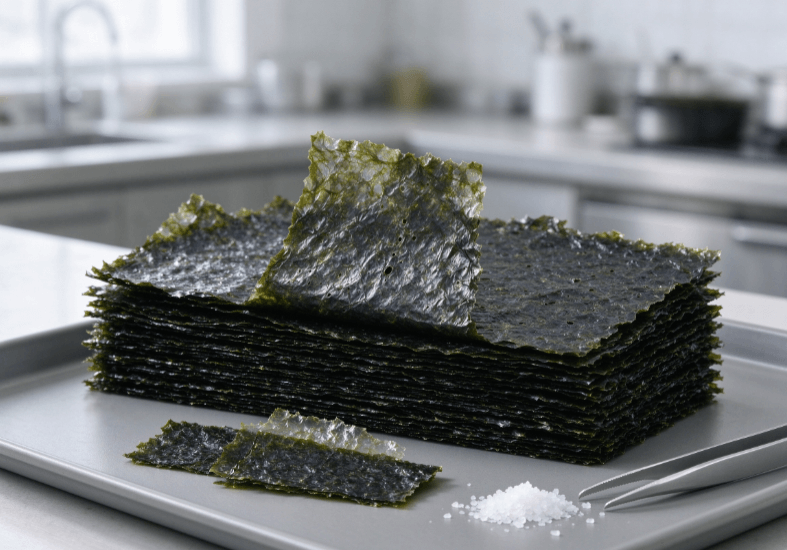
The foundation of any retail seaweed product lies in the harvest timing. Seaweed is an agricultural commodity, and its cellular structure changes drastically as the winter harvesting season progresses.
First-harvest seaweed, collected early in the season, yields the most delicate cell walls and the highest concentration of free amino acids, particularly glutamate and inosinate, which drive the umami flavor profile. Subsequent harvests (second, third, and fourth) produce progressively thicker, more fibrous fronds. These later harvests are often diverted to heavy seasoning applications or industrial ingredient usage, as their natural flavor is milder and their texture requires more aggressive chewing.
Food brands must establish strict raw material specifications before requesting OEM samples. Industrial grading evaluates color depth, hole count, surface gloss, and brittleness.
| Grade Category | Structural & Visual Markers | Target Retail Application |
| Gold / A Grade | Deep black-green, flawless flat surface, fragile snap, high umami. | Premium organic lines, high-end private label brands. |
| Silver / B Grade | Dark green, minor edge imperfections, solid structural crunch. | Mainstream flavored snacks, high-volume grocery. |
| Blue/Green / C Grade | Lighter green, visible spotting or holes, thicker bite. | Discount brands, bulk foodservice supply. |
Selecting an inappropriate grade for your target demographic will immediately trigger consumer complaints regarding texture. Over-speccing the material for a budget retail line will unnecessarily consume your profit margins.
Manufacturing Execution: Roasting and Oil Application
Once the raw material is graded, the processing technology dictates the shelf stability of the snack.
Modern facilities utilize continuous infrared roasting tunnels. Infrared energy penetrates the seaweed sheet uniformly, ensuring consistent moisture evaporation without burning the delicate edges. Legacy convection ovens often struggle with heat distribution, leaving localized moisture pockets that cause the sheet to become chewy within weeks of packaging.
For seasoned variations (e.g., sesame oil, sea salt, teriyaki), the application equipment must be highly calibrated. High-speed manufacturing lines use automated atomizing sprayers to apply a precise micro-layer of oil. If a factory relies on older, less precise spraying mechanisms, excessive oil will pool on the sheet. This excess oil rapidly oxidizes inside the sealed bag, leading to premature rancidity and a sharp drop in shelf life.
Barrier Packaging and Moisture Vapor Transmission
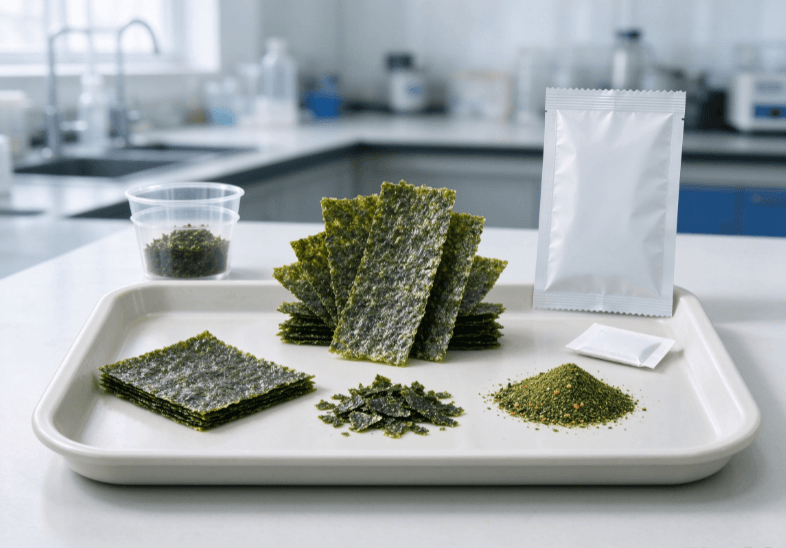
Roasted seaweed is intensely hygroscopic. It acts as a sponge for ambient humidity. The moment moisture vapor penetrates the retail pouch, the product loses its defining crunch.
Flexible packaging for these snacks cannot use standard mono-layer plastics. Importers must specify multi-layer lamination structures. A standard configuration is PET/AL/PE (Polyethylene Terephthalate / Aluminum Foil / Polyethylene). The aluminum layer provides an absolute barrier against Oxygen Transmission Rate (OTR) and Moisture Vapor Transmission Rate (MVTR).
If a brand requires a transparent window on the packaging to display the product, the foil layer must be replaced with an ALOx (Aluminum Oxide) or SiOx (Silicon Oxide) coated PET film. Standard clear plastics will fail in this application.
Internal moisture control is actively managed during the sealing phase. Food-grade silica gel or calcium chloride desiccants are deposited into every pouch. The packaging line must also feature nitrogen flushing capabilities to displace residual oxygen before the final thermal seal is applied.
Supplier Audit Workflows for Importers
Relying solely on Alibaba profiles or trade show conversations introduces massive supply chain risk. Importers must conduct a technical audit of the manufacturer’s operational capabilities and regulatory compliance.
The first step is verifying baseline production scope. Procurement teams should examine the supplier’s sushi nori product categories to ensure the factory operates the exact cutting, rolling, and secondary processing lines required for the specific SKU. A factory that only produces bulk 50-sheet catering packs may not have the automated pick-and-place equipment necessary for 5-gram retail snack trays.
Next, assess their food safety management system. For entry into the US or EU markets, a factory must operate beyond basic GMPs. Importers should demand current GFSI-recognized audit certificates, FDA facility registration numbers, and detailed HACCP plans. This documentation is critical for passing Foreign Supplier Verification Programs (FSVP).
Evaluating their raw material supply chain is equally important. Factories that own their coastal aquaculture farms or hold exclusive contracts with local cooperatives offer better price stability and traceability. For a deeper breakdown of supplier evaluation frameworks, reviewing industry guidelines on how to choose a sushi nori supplier provides a highly practical roadmap for assessing origin traceability and roasting consistency.
OEM Cost Drivers and Procurement Realities
Understanding exactly where costs originate allows buyers to negotiate manufacturing agreements based on reality rather than arbitrary target prices.
- Packaging Film MOQs: The most significant hurdle for new private label launches is the packaging film. Custom rotogravure printing requires the buyer to pay for copper printing cylinders for each color in the design. Furthermore, the laminated film manufacturer typically demands a minimum run of 10,000 to 30,000 bags per SKU.
- Seasoning Complexity: Utilizing certified organic sunflower oil, specialized Himalayan pink salt, or custom flavor dusts (like vegan cheddar or sriracha) increases the manufacturer’s blending costs. It also forces longer line-clearing and sanitation procedures between batches.
- Harvest Seasonality: Raw nori prices fluctuate based on ocean temperatures and seasonal yield. Securing a year-long supply contract immediately after the winter harvest often yields better unit economics than buying on the spot market in mid-summer.
FAQ
What is the minimum order quantity (MOQ) for custom private label seaweed snacks?
The MOQ is almost entirely dictated by the custom printed packaging film, not the seaweed itself. For multi-layer barrier pouches, expect an MOQ of 20,000 to 30,000 units per flavor (SKU). Buyers can sometimes negotiate lower volumes if using generic bags with custom applied labels, though this increases per-unit labor costs.
How long are production lead times for international OEM orders?
An initial production run typically requires 35 to 45 days. This accounts for custom packaging cylinder engraving, film printing, lamination curing, and the actual roasting/packing process. Subsequent reorders using existing film inventory usually drop to a 15 to 20-day production lead time.
What testing parameters should be included in the product specification sheet?
Your spec sheet should strictly define the maximum moisture content (typically <3%), acceptable water activity (aw), target weight per sheet, and microbiological limits (Total Plate Count, Coliforms, Salmonella).
Can we manufacture organic certified private label snacks?
Yes, but both the raw seaweed and all applied oils/seasonings must carry organic certification. Additionally, the manufacturing facility itself must be certified to process organic foods, ensuring proper segregation protocols to prevent cross-contamination with conventional products.
Reference Sources
- U.S. Food and Drug Administration (FDA): FSMA Final Rule on Foreign Supplier Verification Programs (FSVP) for Importers of Food for Humans and Animals.
- BRCGS (Brand Reputation Compliance Global Standards): Global Standard Food Safety Issue 9, focusing on senior management commitment, HACCP, and quality management systems.
- ASTM F1249-20: Standard Test Method for Water Vapor Transmission Rate Through Plastic Film and Sheeting Using a Modulated Infrared Sensor.
- Food and Agriculture Organization (FAO): Technical papers on the post-harvest processing, drying, and storage of commercial macroalgae.