

Regular nori sheets are complete, pressed sheets formed from processed seaweed and roasted for a crisp, aromatic texture. Their fiber network must remain strong enough for filling, rolling, folding, and portioning.
Shredded nori, also called kizami nori, is made from roasted nori that passes through precision cutting equipment. It becomes narrow strips that can be used immediately without staff cutting or tearing sheets.
The materials may be similar, but priorities differ. Whole sheets need structural strength. Shredded nori needs clean cutting, consistent strips, limited fines, and rapid flavor release.
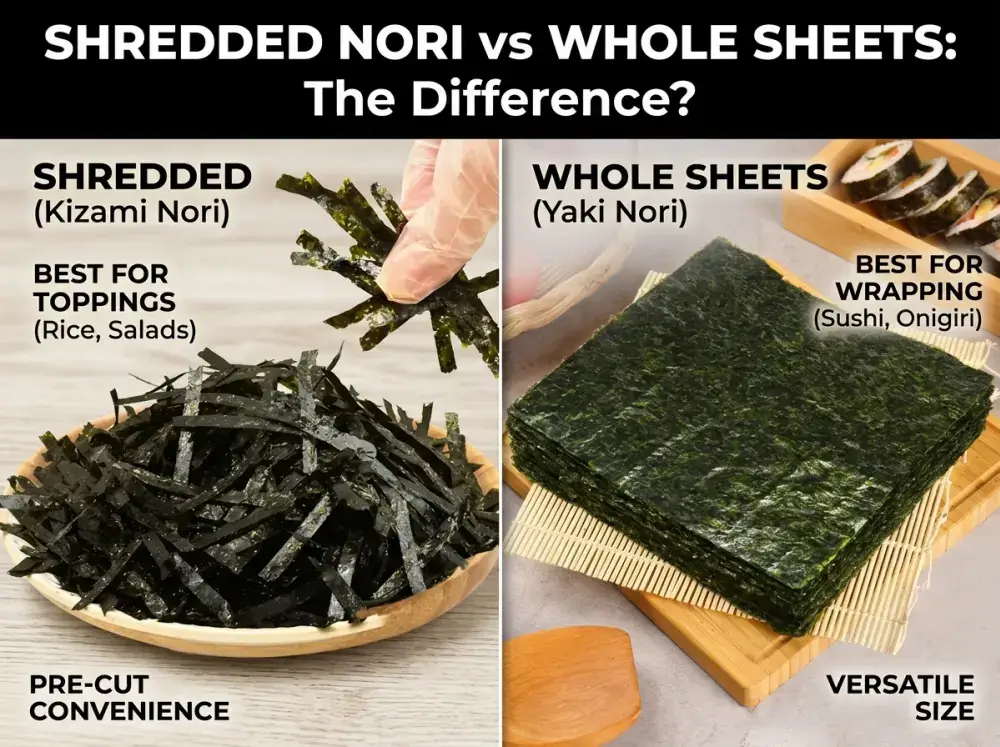
Shredded Nori vs Whole Sheets Comparison Table
| Dimension | Shredded Nori | Regular Nori Sheets |
| Product Format | Narrow roasted seaweed strips, commonly called kizami nori | Complete rectangular roasted seaweed sheets |
| Key Processing | Roasting, precision mechanical cutting, and size screening | Forming, pressing, drying, roasting, and sheet inspection |
| Primary Applications | Ramen, rice bowls, cold noodles, prepared foods, and seasoning blends | Sushi rolls, onigiri, hand rolls, wraps, and plated portions |
| Texture & Handling | Light, crisp, easy to scatter, but more exposed to humidity | Flexible enough for wrapping and filling |
| Best Suited For | Topping, blending, fast service, and industrial processing | Portion-controlled wrapping and visual presentation |
How Do Raw Materials and Processing Affect Quality?
Raw-material selection is central to both formats. Seaweed intended for whole sheets needs an even fiber structure, stable color, clean aroma, and sufficient tensile strength after roasting.
For shredded products, the raw material must cut cleanly instead of collapsing into powder. Color, aroma, and crispness still matter, but minor visual defects may be less important when the product becomes a topping or blended ingredient.
A commercial production flow typically includes:
•Raw seaweed inspection for color, odor, foreign material, and defects.
•Cleaning and preparation before forming or roasting.
•Sheet forming, pressing, drying, and roasting for whole-sheet products.
•Precision slitting or cutting for shredded products.
•Screening for strip width, fines, metal, and other physical contaminants.
•Final packing under controlled humidity conditions.
Cutting equipment is central to shredded nori vs whole sheets. Dull blades create irregular strands and fines. Request strip width, tolerance, and a visual sample before approval.
Roast level also changes the result. A lighter roast preserves delicate aroma, while a deeper roast creates a stronger toasted note. Setting depends on the recipe.
When Should Food Businesses Choose Shredded Nori?
In shredded nori vs whole sheets, shredded nori suits toppings, garnishes, and blended ingredients. Its narrow shape distributes aroma and reduces preparation work.
Typical applications include:
•Ramen and noodle dishes: Strips add roasted aroma without requiring staff to tear sheets.
•Seafood rice bowls: Kizami nori creates a visible topping with simple portioning.
•Cold noodles and salads: Small strands spread across the surface and combine with dressing.
•Prepared meals: The format fits trays, bowls, meal kits, and frozen foods.
•Seasoning blends: Shredded seaweed mixes with sesame, salt, spices, or rice seasonings.
•Food processing: Strips work in fillings, sauces, snacks, and frozen foods.
The operational benefit of shredded nori vs whole sheets is speed. Staff can scatter measured portions directly. Its exposed edges absorb humidity faster, so match pack size to consumption.
When Are Whole Nori Sheets the Better Choice?
For shredded nori vs whole sheets, whole sheets are better when seaweed must hold ingredients or create a recognizable shape. Standard dimensions support recipe consistency.
Typical uses include:
•Sushi rolls: The sheet provides a continuous wrapper for rice and fillings.
•Onigiri: A full or half sheet can wrap rice and protect the eating surface.
•Hand rolls: The large format supports cone shaping and immediate service.
•Sushi sandwiches and wraps: Sheets provide visual coverage and structural support.
•Retail portions: Standard dimensions simplify recipe costing and inventory control.
Once opened, whole sheets can lose crispness, curl, or stick together. Store them away from steam, dishwashers, condensation, and wet refrigeration zones.
Commercial Guide: shredded nori vs whole sheets
When comparing shredded nori vs whole sheets, start with the finished application. A lower unit price may not reduce total cost if staff must cut sheets or manage waste.
Use this checklist when evaluating shredded nori vs whole sheets:
•Application fit: Confirm whether the product wraps, garnishes, blends, or fills.
•Product specification: Define dimensions, thickness, roast level, color, strip width, and tolerance.
•Moisture target: Ask for the supplier’s specification and test method. Commercial nori is often controlled within a low-moisture range, commonly below 3–5%, depending on the product and market.
•Crispness testing: Check texture at receipt and after simulated storage.
•Barrier packaging: Prefer food-grade high-barrier packaging, commonly an aluminum-foil laminate or equivalent.
•Desiccant configuration: Confirm whether a food-safe desiccant is included and meets local requirements.
•Shelf-life validation: Review storage temperature, humidity limits, and best-before coding.
•Traceability: Request lot codes, production dates, raw-material records, and recall procedures.
•Application sampling: Test the sample in the actual recipe, not only by visual inspection.
Moisture Control and Packaging
Moisture is a major quality risk in both formats. It reduces crispness, weakens aroma, changes bite, and may cause sheets to curl or stick.
A suitable commercial pack should limit oxygen and humidity transfer. Barrier film, heat seals, carton protection, and desiccant configuration should match distribution and opening frequency.
This point is critical in shredded nori vs whole sheets because shredded products have more exposed surface area. Humid transport may require stronger barrier protection.
Mixed Purchasing and Private Label
Restaurant groups often need both formats: whole sheets for sushi stations and shredded nori for ramen, bowls, and prepared meals.
Ask whether mixed SKUs can be consolidated under one purchase order. Confirm the MOQ per format, private-label artwork, carton dimensions, pallet configuration, and sample lead time before approval.
Haipu Food supplies Puno Tai and HaddieBear products and discusses B2B development. Confirm specifications, labels, allergens, and market requirements in writing.
Why Do Factory Systems Matter in shredded nori vs whole sheets?
A reliable nori program needs more than one good sample. Evaluate hazard controls, production records, and repeated-lot verification.
Controls may include HACCP analysis, sanitation checks, roasting parameters, moisture testing, seal inspection, metal detection, and X-ray screening.
For international orders, documentation is part of product quality. Haipu Food identifies ISO9001, HACCP, Halal, SGS, and Export Food Manufacturer Registration among its export-related qualifications and documentation. Certificate scope and validity should be verified for the relevant facility and shipment.
FAQ for Commercial Nori Buyers
Which lasts longer in shredded nori vs whole sheets?
Shelf life depends on moisture, roasting, packaging, storage, and opening frequency. Compare the supplier’s validated specification rather than assuming one format always lasts longer.
Can buyers combine shredded nori vs whole sheets in one bulk order?
Often, yes, but terms depend on production schedules and minimum order quantities. Ask for the MOQ per SKU and carton-consolidation options.
What packaging is recommended for humid markets?
Use high-barrier inner packaging with reliable heat sealing, carton protection, and a food-safe desiccant where required. Request humidity and transit recommendations for ocean freight or tropical distribution.
Can strip size, roast level, or packaging be customized?
Many manufacturers can discuss strip width, roast profile, seasoning, pack weight, label design, and carton configuration. Approve a pre-production sample and written specification before placing a customized order.
Industry Quality and Compliance Standards Cited
•HACCP: Hazard analysis and critical control point management for food-safety risks.
•ISO 9001: Quality-management principles supporting documented and repeatable processes.
•Halal: Compliance pathway for products supplied to Halal markets, subject to certificate scope.
•SGS: Independent inspection, testing, or verification services, depending on the agreed program.
•FDA requirements: U.S. market requirements may cover facility registration, labeling, food safety, and importer responsibilities.
•Export Food Manufacturer Registration: Registration and documentation requirements vary by destination market.
The right choice in shredded nori vs whole sheets depends on the recipe, service model, packaging route, and purchasing plan. Whole sheets suit wrapping; shredded nori suits fast topping and blending. A qualified manufacturer can match grade, roast profile, cut specification, packaging, and compliance documents to the application.