

For seasoned seaweed wholesale, buyers should evaluate product format, moisture protection, factory capacity, certifications and landed cost together. This is the foundation of a reliable seasoned seaweed wholesale plan. A direct manufacturer such as Lianyungang Haipu Food Co., Ltd. can support consistent bulk production, private label development and export documentation from one production base.
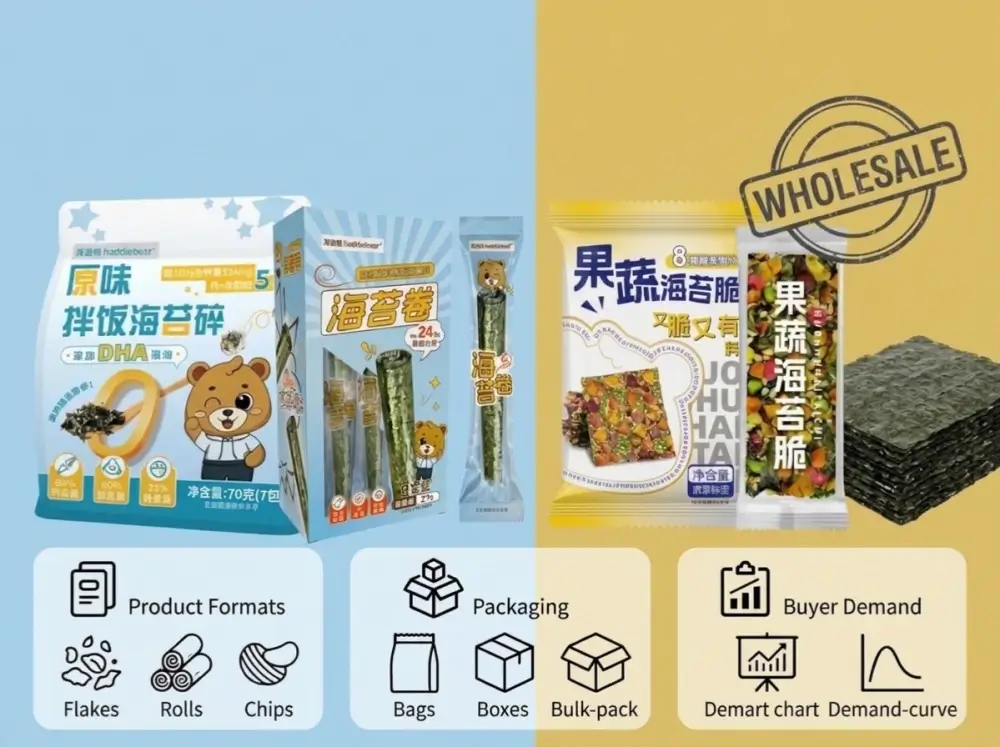
What Should Buyers Check in Seasoned Seaweed Wholesale?
A seasoned seaweed wholesale purchase is not simply a comparison of prices per carton. The product must match the buyer’s sales channel, handling conditions, shelf-life target and import regulations.
Most professional buyers assess four areas before approving a supplier. These checks make seasoned seaweed wholesale decisions more predictable:
•Product format and application fit.
•Packaging performance during long-distance ocean freight.
•Manufacturing capacity, quality controls and MOQ flexibility.
•Export compliance, testing and traceability documentation.
Product Formats for Wholesale Buyers
The correct format depends on how the product will be sold or used. Retailers often need attractive consumer packs, while restaurants and food manufacturers usually prioritize yield, labor savings and cost per serving.
Retail seasoned seaweed packs are suitable for supermarkets, convenience stores and online grocery channels. They may contain individual sheets, small snack portions or flavored nori pieces. Buyers normally request barcode placement, multilingual labels, nutrition panels and retail-ready cartons.
Bulk seasoned nori flakes are designed for food-service kitchens, sushi operators, rice bowl brands and prepared-food manufacturers. Large bags reduce packaging waste and simplify portioning. Flakes can be sprinkled over rice, noodles, salads, soups and ready meals.
Seasoned nori for rice is commonly supplied in sheet, strip or flake formats. The specification should state sheet size, cut width, seasoning profile, salt level, oil content and target application. These details help maintain consistency across restaurant locations or production lines.
Private label seasoned seaweed bulk gives importers control over brand identity and retail positioning. A project may include custom seasoning, artwork, pack size, carton design and language adaptation. The supplier should confirm which changes affect tooling, lead time and MOQ.
Wholesale Product Formats and Packaging Specifications
The following comparison can help buyers create a practical sourcing brief before requesting seasoned seaweed wholesale quotations.
| Product Format | Target Market | Packaging Type | Typical MOQ |
| Small seasoned nori snack packs | Supermarkets, convenience stores, e-commerce | Individual foil-laminate packs in retail cartons | Factory-dependent; often several thousand packs |
| Seasoned nori sheets for rice | Sushi chains, rice bowl brands, food-service distributors | Inner sealed bags, master cartons, optional retail packs | Usually based on cartons or production batches |
| Bulk seasoned nori flakes | Restaurants, meal factories, ingredient wholesalers | Large moisture-barrier bags inside export cartons | Often one or more pallet quantities |
| Shredded seasoned nori | Food manufacturers, topping suppliers, catering | Sealed bags, lined cartons or customized pouches | Depends on cut size and annual volume |
| Private label seasoned seaweed | Importers, retail chains, brand owners | Custom printed pouches, trays or multipacks | Artwork and packaging MOQ may apply |
How Does Packaging Protect Seasoned Nori During Ocean Freight?
Moisture control is central to every seasoned seaweed wholesale program. Nori is thin and hygroscopic, so exposure to humid air can reduce crispness, change texture and shorten its commercial shelf life.
For container shipments, buyers should request a documented packaging specification. A common structure is PET/AL/PE aluminum foil laminate. PET provides printability and strength, aluminum offers a strong light and moisture barrier, and PE supports heat sealing.
Important Packaging Questions
•Is the primary pack heat sealed and leak tested?
•Is nitrogen flushing available for the selected format?
•Does the package include an oxygen and moisture barrier?
•Are inner bags protected from carton compression?
•What are the master carton dimensions and gross weight?
•How many cartons fit on a pallet or in a 20-foot container?
•Are desiccants or humidity indicators needed for the route?
Nitrogen flushing can reduce oxygen inside a sealed pack and help protect flavor and appearance. It is a useful seasoned seaweed wholesale packaging option. It should be validated against the product’s oil content, film structure and intended shelf life.
A seasoned seaweed wholesale factory should not promise a universal shelf life without considering formulation and logistics. During commercial trials, buyers should compare retained samples before shipment and after simulated storage.
What Are the Core Requirements for a Commercial Seaweed Factory?
A reliable seasoned seaweed wholesale supplier needs more than modern equipment. The factory must demonstrate repeatable processes, realistic production planning and clear communication when specifications change.
Automated Batch Production
Haipu Food uses continuous roasting and automated seasoning-spray lines to support batch consistency. Controlled processing can help stabilize color, flavor distribution and texture across larger orders.
The buyer should ask how the factory controls seasoning dosage and roasting conditions. This evidence supports repeatable seasoned seaweed wholesale production. Important records may include batch numbers, production dates, line identification and process checks.
Moisture Control and Shelf-Life Management
For seasoned seaweed wholesale, a practical moisture target may fall below 3–5%. The exact limit should be agreed in the product specification, because flakes, sheets, oil levels and seasoning formulas behave differently.
A qualified factory should conduct rapid laboratory moisture testing during production and before release. It should also maintain retained samples for complaint investigation and quality comparisons.
Accelerated shelf-life testing can help identify packaging or formulation risks before a full commercial launch. Buyers should review the test conditions, test duration and relationship to the proposed expiry date.
Traceability and Final Inspection
Each commercial batch should be traceable from raw material intake through production, packing and shipment. Lot codes should connect the finished product with production records and laboratory results.
A complete release process may include:
•Moisture and sensory checks.
•Weight and seal-integrity verification.
•Metal detection and X-ray foreign-object screening.
•Microbiological testing where required by the specification.
•Review of packaging artwork and date coding.
•Certificate of Analysis, or COA, issuance.
The COA should match the shipment lot and identify the tested parameters. Buyers should avoid accepting generic certificates that cannot be linked to the actual container.
Why Do Certifications Matter in Seasoned Seaweed Wholesale?
Certifications reduce commercial and regulatory uncertainty. They do not replace buyer audits, product testing or local legal review, but they provide an important baseline for supplier qualification.
Haipu Food reports ISO9001, HACCP, Halal, SGS and Export Food Manufacturer Registration credentials. The buyer should request current copies and confirm that the certification scope covers the relevant facility and product category.
HACCP demonstrates a preventive approach to biological, chemical and physical hazards. ISO9001 supports documented quality-management procedures and corrective-action practices.
Halal certification is essential for buyers serving markets or consumers requiring compliant ingredients and processing controls. SGS reports may support independent verification of selected quality or safety parameters.
For the destination market, the importer should also review applicable FDA, labeling, allergen, additive, packaging and residue requirements. Responsibility can be divided between the factory and importer, but it should be documented before production.
A Practical Buyer Checklist Before Placing a Bulk Order
During seasoned seaweed wholesale supplier comparison, request the following information in writing:
•Product specification with dimensions, ingredients and tolerance limits.
•Seasoning formula or allergen declaration, subject to confidentiality limits.
•Moisture target and testing method.
•Sample packaging, carton dimensions and loading plan.
•MOQ for standard products and private label products.
•Production lead time after artwork and deposit approval.
•COA template and shipment-specific testing plan.
•Certification copies and recent third-party reports.
•Incoterm, payment schedule and document package.
•Complaint procedure, retained-sample policy and corrective-action process.
A direct source factory can shorten communication between formulation, production, packaging and export teams. This advantage is important in seasoned seaweed wholesale. Haipu Food’s product portfolio and automated production base may suit wholesalers seeking seasoned nori, rice toppings, shredded formats or OEM/ODM development.
FAQ for International Wholesale Buyers
What MOQ is common for bulk seasoned seaweed shipments?
There is no single global MOQ. Standard products may start from pallet-level quantities, while printed private label packaging usually requires a higher commitment. Confirm product, packaging and flavor-development MOQs separately.
How long does private label customization take?
The timeline depends on formula approval, artwork, packaging material and production scheduling. A realistic quotation should separate sampling, artwork confirmation, packaging production and bulk manufacturing lead times.
Can overseas buyers receive samples before placing an order?
Yes, buyers should request representative samples before approving a purchase. Samples should include the proposed flavor, format and packaging type whenever possible. Freight, courier documents and customs responsibilities should be agreed in advance.
Which payment and customs terms should buyers clarify?
Clarify the Incoterm, deposit balance, shipment documents, inspection point and responsibility for import clearance. Confirm whether the supplier provides the commercial invoice, packing list, bill of lading and COA.
Industry Quality & Compliance Standards Cited
•HACCP: Preventive hazard analysis and critical control management.
•ISO9001: Documented quality-management and corrective-action systems.
•Halal: Requirements for compliant ingredients and production practices.
•SGS: Independent third-party testing or inspection support.
•FDA requirements: Destination-market review for labeling, ingredients and food safety.
•Export Food Manufacturer Registration: Facility registration and export documentation support.
In seasoned seaweed wholesale, the strongest supplier is not necessarily the one offering the lowest unit price. It is the factory that can repeat the approved product, protect it through shipment and provide evidence for every commercial batch. A structured review of formats, packaging, factory controls and compliance gives buyers a stronger basis for long-term sourcing decisions.