

Seaweed snack MOQ is mainly determined by packaging materials, product customization, production setup, and the factory’s efficient batch size. For OEM buyers, the lowest practical quantity is rarely set by seaweed alone.
Importers, private-label brands, supermarket buyers, and wholesalers should evaluate the complete production system. Printed film, barrier performance, seasoning, pack size, and carton loading can change the minimum order quantity significantly.
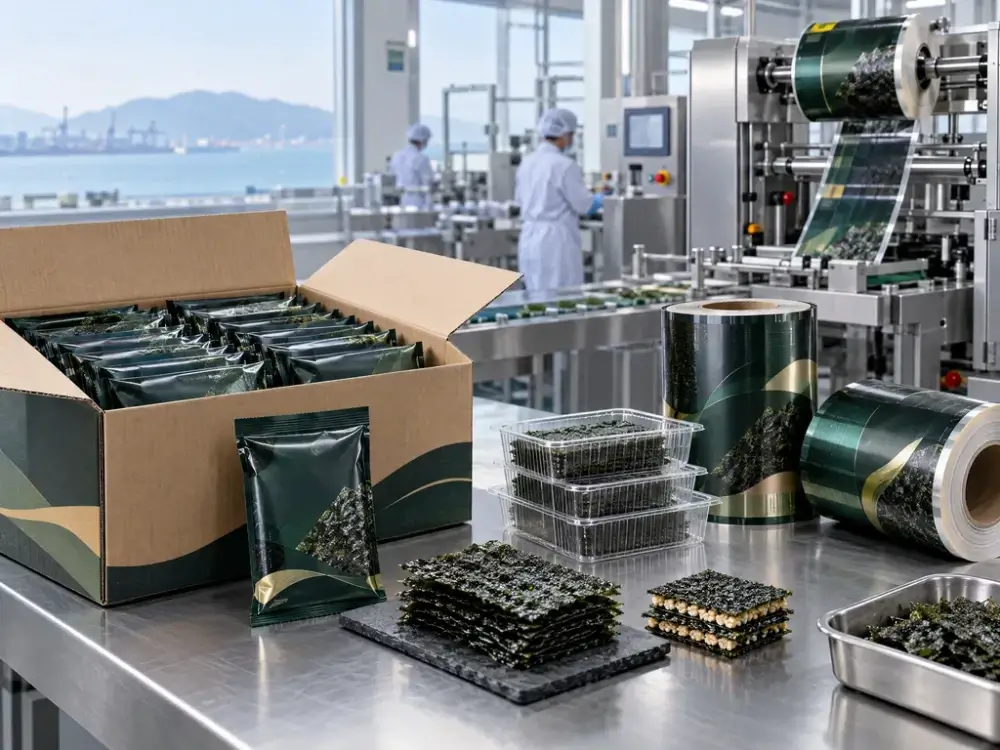
What Determines Seaweed Snack MOQ in OEM Production?
A seaweed snack MOQ reflects the smallest batch a factory can produce without creating excessive material waste or unstable production costs. The key variables are usually linked to packaging and customization.
1. Product format and dimensions
A single-sheet roasted seaweed pack requires different equipment settings from a sandwich nori snack, shredded nori, or seasoned seaweed for rice. Pack dimensions also affect how many bags fit on a film roll and inside a master carton.
Typical variables include sheet size, pack weight, pouch or display-box format, tray dimensions, and outer-carton loading.
2. Raw material grade and harvest season
Nori quality varies by growing area, harvest period, color, texture, thickness, and flavor profile. Higher grades are often selected for premium sushi nori or clean-label snack products.
Factories normally classify incoming raw material before roasting. This helps match the seaweed sheet with the intended application, rather than treating all raw material as interchangeable.
3. Roasting, seasoning, and moisture control
Roasting must create a crisp texture without burning the sheet or producing excessive breakage. Seasoning may involve oil, salt, sugar, sesame, chili, seafood notes, or other approved flavor systems.
For crisp seaweed snacks, moisture control is critical. A practical manufacturing target is commonly below 5% moisture, subject to the product specification and validation results.
Seasoning customization can raise the seaweed snack MOQ because the factory may need to purchase dedicated ingredients, clean the seasoning line, and validate the formula before full production.
Packaging Is Often the Biggest MOQ Driver
Many OEM buyers assume the seaweed snack MOQ is controlled by the quantity of finished food. In practice, printed packaging often creates the binding constraint.
Printed film and cylinder costs
Custom rotogravure printing may require cylinders for each color. Cylinder preparation creates a fixed cost before the first saleable package is produced.
Film converters also set minimum production quantities for each structure and artwork. A buyer may need to order more film than the first production run consumes, especially when the artwork uses several colors or a complex laminate.
The factory must account for cylinder preparation, film-converter MOQ, roll width, start-up waste, and remaining inventory after the initial order.
This is why stock packaging can support a lower seaweed snack MOQ than fully customized private-label packaging.
Moisture barriers and nitrogen flushing
Seaweed absorbs moisture quickly after roasting. Packaging must protect texture during shipping, storage, and retail display.
A common high-barrier structure is PET/AL/PE laminated film. The exact material selection depends on shelf-life targets, sealing performance, print requirements, market regulations, and the product’s oil and seasoning profile.
Nitrogen flushing can reduce oxygen inside the package and help limit oxidation. It also requires compatible filling equipment, stable sealing conditions, and sufficient production volume to justify line setup and quality checks.
Trays and master cartons
PET inner trays help protect fragile snack sheets and maintain the retail presentation. Their dimensions must match the bag, product count, and carton design.
Master cartons also influence freight cost and pallet stability.
Stock Packaging vs. Custom Private Label MOQ
The most economical route depends on the buyer’s sales plan. Stock packaging reduces tooling and material risk, while private-label packaging offers stronger brand control but requires more preparation.
| Production option | Typical MOQ pressure | Main cost driver | Best suited for |
| Stock packaging | Lower | Finished goods batch size | Market testing, distributors, smaller wholesalers |
| Stock packaging with buyer labels | Low to moderate | Label printing and application | Early-stage private-label programs |
| Custom printed pouch | Moderate to high | Film rolls, cylinders, artwork setup | Established brands and retail launches |
| Custom pouch with special tray | Higher | Film, tray tooling, and carton setup | Premium shelf-ready products |
| Custom flavor and packaging | Highest | Formula validation, ingredients, film, and production setup | Scaled brands and long-term programs |
For a first launch, stock packaging or a simplified custom design can reduce risk. Dedicated film and special trays can follow after demand is proven.
How Can OEM Buyers Lower Their Seaweed Snack MOQ?
Consider the following approaches:
•Use a standard bag size and existing production format.
•Start with one flavor instead of several variants.
•Use stock packaging for initial market validation.
•Apply a high-quality label rather than ordering custom printed film.
•Select standard PET/AL/PE barrier structures where suitable.
•Avoid unusual tray dimensions during the first launch.
•Combine several approved flavors into a planned production schedule.
•Share one master carton format across related SKUs.
•Forecast repeat orders before approving a large film purchase.
•Confirm the destination country’s labeling and import requirements early.
Seaweed Snack MOQ Cost Structure: What Are You Really Paying For?
A quoted seaweed snack MOQ should be reviewed as a cost structure, not only as a unit count. A low quantity with a high unit price may be less useful than a moderate batch with better material utilization.
The main cost elements are raw seaweed, roasting and seasoning, film and other packaging, setup and sealing tests, quality control, and export logistics.
Buyers should confirm whether excess film or trays are billed, stored, or written off after the first order.
Lianyungang Haipu Food Co., Ltd. operates a 20,000-plus-square-meter manufacturing base in Lianyungang, China, with more than 100 sets of automated equipment. Its product capabilities include sushi nori, sandwich nori, shredded nori, and seasoned seaweed for rice.
For a final quotation, buyers should provide the destination market, product format and weight, flavor restrictions, packaging status, expected annual volume, certification needs, shelf-life target, and delivery port.
This information helps separate a technical minimum from a commercially recommended seaweed snack MOQ.
Samples, Lead Times, and Production Planning
Samples do not always use the same materials as mass production. A factory may provide a product sample with stock film first, then prepare a digital or printed packaging proof for approval.
A typical OEM workflow includes:
•Product and flavor specification review.
•Sample preparation and buyer evaluation.
•Artwork, packaging, and regulatory review.
•MOQ confirmation and pre-production approval.
•Mass production, inspection, and export preparation.
Lead time depends on film printing, cylinder preparation, ingredient availability, production scheduling, and approval speed. Custom printed packaging normally requires more planning than stock packaging.
Haipu Food supports international OEM projects through systems including ISO 9001, HACCP, Halal, SGS-related testing support, and export food manufacturer registration. Buyers should confirm which documents apply to their product and market.
FAQ for B2B Seaweed Snack Buyers
What is a reasonable seaweed snack MOQ for a first OEM order?
There is no single global minimum. Stock packaging usually allows a lower entry quantity, while custom film, special trays, multiple flavors, and nitrogen flushing require a larger batch.
Can I order custom packaging with a small quantity?
Sometimes, but the unit cost may rise sharply. A label-on-stock-packaging solution or a simplified printed design can reduce the initial seaweed snack MOQ.
Are samples included in the MOQ?
Usually, product samples are handled separately from mass production. Packaging samples, printed proofs, courier costs, and formula development may have separate charges.
How long does OEM production take after approval?
The schedule depends on packaging material availability, artwork approval, raw material planning, and factory capacity. Stock packaging is generally faster than custom rotogravure printing.
Industry Quality and Compliance Standards Cited
•HACCP: Preventive food-safety controls across receiving, processing, packaging, and storage.
•ISO 9001: Documented quality-management processes.
•Halal: Requirements for eligible ingredients, handling, and processing.
•SGS testing: Independent testing for buyer-specified microbiological, chemical, or packaging requirements.
•FDA requirements: Applicable U.S. food, labeling, facility, and import rules.
•Export food manufacturer registration: Destination-market registration and shipment documentation.
The right seaweed snack MOQ supports safe production, compliant packaging, stable quality, and realistic landed costs. Reviewing film, barrier materials, specifications, and repeat-order potential together leads to a more reliable purchasing decision.