

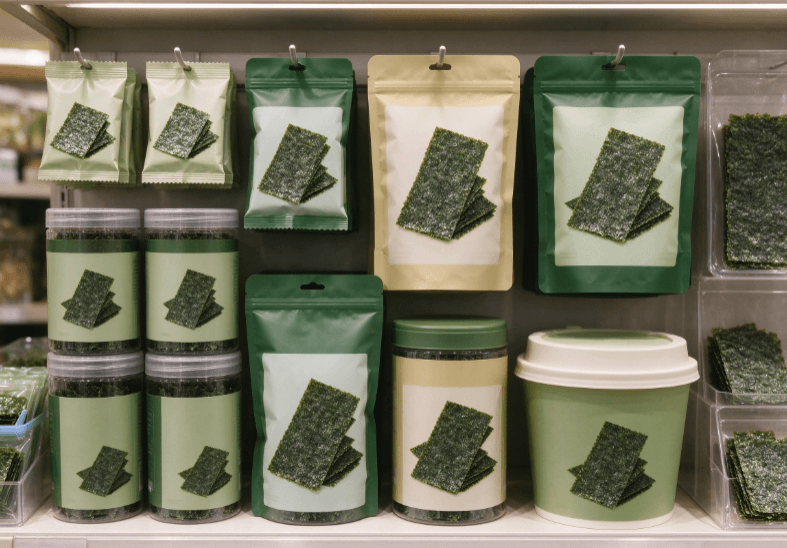
Seaweed snack packaging should combine a strong moisture barrier, suitable oxygen protection, and reliable sealing to preserve crispness, flavor, and shelf life. Aluminum foil laminates and high-barrier metallized films are common options, while rigid containers provide additional protection against breakage. The best choice depends on the seaweed formulation, serving size, distribution conditions, and required shelf life.
For roasted seaweed snacks, packaging is more than a retail presentation. Thin seaweed sheets readily absorb atmospheric moisture, while oils and seasonings may introduce additional oxidation risks.
Choosing a suitable packaging structure requires understanding which quality changes must be prevented and how the finished product will be handled.
Why Does Seaweed Snack Packaging Need a Moisture Barrier?
Roasted seaweed has a thin, porous structure that readily absorbs moisture from surrounding air.
Even limited humidity exposure can change its texture from crisp to flexible or chewy. This deterioration may occur before visible changes appear.
Packaging must therefore protect the product throughout storage, transportation, and retail display.
The main protection requirements include:
- Moisture resistance: Reduces water vapor entering the package.
- Oxygen protection: Helps limit oxidation of oils and sensitive flavor compounds.
- Light protection: Reduces exposure that may contribute to pigment or flavor deterioration.
- Physical protection: Prevents fragile sheets from breaking.
- Seal integrity: Maintains the protective environment inside the package.
Packaging requirements can also change with the product formulation.
Plain roasted nori and oil-seasoned snacks do not always require identical protection. Added oils may increase sensitivity to oxidation.
The differences between roasted, seasoned, and layered products are explained in What Are Seaweed Snacks? A Complete Guide to Nori Foods.
Understanding WVTR and OTR
Two technical measurements help evaluate packaging performance.
Water Vapor Transmission Rate (WVTR) measures how much water vapor passes through a packaging material under specified conditions.
Lower WVTR generally indicates better moisture resistance.
Oxygen Transmission Rate (OTR) measures oxygen transmission through a packaging material.
Lower OTR can help protect oxidation-sensitive ingredients.
Both values depend on test temperature, humidity, and material structure.
ASTM F1249 provides a standardized method for measuring WVTR, while ASTM D3985 addresses oxygen transmission through plastic films.
Neither measurement alone guarantees a particular product shelf life.
Which Packaging Materials Work Best for Seaweed Snacks?
Flexible multilayer packaging is widely used for moisture-sensitive foods because different layers perform different functions.
One layer may provide barrier protection, while another contributes mechanical strength or heat-sealing performance.
Aluminum Foil Laminates
Aluminum foil laminates provide strong barriers against moisture, oxygen, and light when properly manufactured.
A typical construction may combine polyester, aluminum foil, and polyethylene sealing layers.
Such structures can be suitable for roasted seaweed intended for extended distribution.
However, foil laminates may cost more than simpler films. Folding damage, pinholes, and sealing defects can also reduce protection.
Metallized Plastic Films
Metallized films use a thin deposited metal layer to improve barrier performance.
These materials are generally lighter than conventional foil laminates and may provide useful protection at a competitive cost.
Their performance depends on coating quality, film structure, and handling conditions.
A metallized appearance does not automatically guarantee high moisture resistance.
Transparent Plastic Films
Transparent films allow consumers to see the product.
This can be useful for specialty snacks, but material selection requires care.
Basic polyethylene or polypropylene films may not provide enough moisture or oxygen protection for demanding shelf-life requirements.
High-barrier transparent structures are available, although their performance and costs vary.
Rigid Containers
Rigid containers can protect fragile seaweed products against crushing during transportation and repeated handling.
However, the container material, closure, and any inner seal must also provide adequate moisture protection.
For example, Haipu’s HaddieBear Crispy Nori Wafer in a 40g can illustrates a rigid retail packaging format.
The product’s actual barrier performance must still be established through its material and sealing specifications.
| Packaging Material | Main Advantage | Main Limitation |
|---|---|---|
| Aluminum foil laminate | Strong moisture, oxygen, and light barriers | Higher material cost; potential flex damage |
| Metallized film | Lightweight with useful barrier potential | Coating performance varies |
| Transparent barrier film | Product visibility | Requires careful material specification |
| Standard PE/PP film | Flexible and economical | May provide insufficient barrier protection |
| Rigid container | Excellent physical protection | Closure and inner seal remain critical |
The strongest material is not always the most suitable choice. Packaging should be selected according to the product’s demonstrated protection requirements.
How Packaging Extends Seaweed Snack Shelf Life
Packaging contributes to shelf life by limiting environmental factors that cause product deterioration.
For roasted seaweed, moisture absorption is frequently the first noticeable problem.
Once humidity enters a package, the seaweed can lose its characteristic crisp texture.
Seasoned products containing added oil face another challenge: lipid oxidation.
Oxidation may produce stale or rancid flavors even when the sheets remain relatively dry.
The ideal packaging system must therefore consider both water vapor and oxygen exposure.
Does Nitrogen Flushing Help?
Nitrogen flushing replaces part of the air inside a package with nitrogen gas.
This can reduce the initial oxygen concentration and help protect oxidation-sensitive ingredients.
However, nitrogen flushing cannot prevent moisture entering through poor-quality packaging.
It also does not compensate for inadequate sealing or handling.
The effectiveness of modified-atmosphere packaging depends on residual oxygen levels, package permeability, and product characteristics.
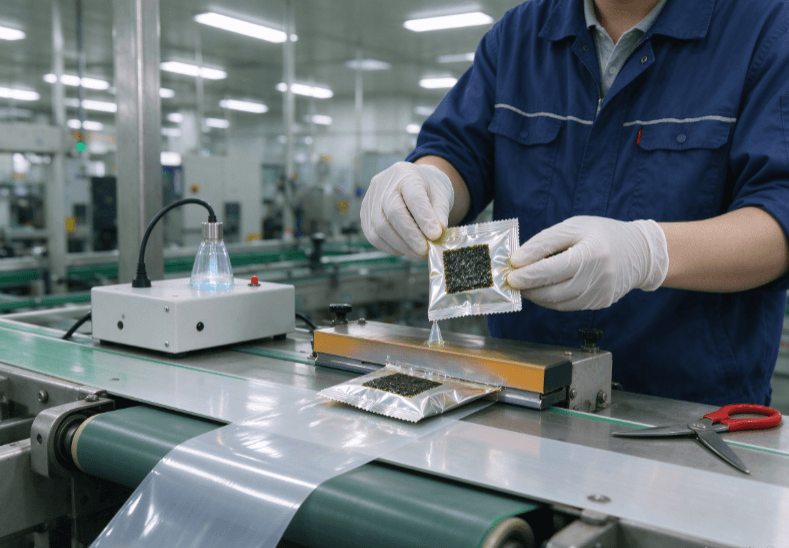
Why Heat Sealing Matters
Packaging failures often occur at the seals rather than across the main film surface.
Possible causes include:
- Inadequate sealing temperature or pressure
- Product particles trapped inside the seal
- Wrinkles across the sealing area
- Incorrect sealing dwell time
- Mechanical damage during transportation
A strong packaging film offers limited protection when moisture can enter through an incomplete seal.
During production, seal strength and leak testing should be included in quality-control procedures.
Can Packaging Guarantee a 12-Month Shelf Life?
No packaging material can independently guarantee a 12-month shelf life.
Actual shelf life depends on initial product quality, formulation, packaging performance, and storage conditions.
Manufacturers should establish shelf-life claims through appropriate testing rather than assuming that aluminum foil or nitrogen flushing provides a fixed preservation period.
For a related discussion of moisture exposure and product quality, see Sushi Nori Shelf Life: How Long Does It Last?.
Selecting Packaging for Different Seaweed Snack Products
The packaging format should match how consumers use the product and how the product moves through distribution.
A single-serving seaweed snack has different requirements from a larger container intended for repeated consumption.
Individually Packaged Roasted Seaweed
Individual packs limit the amount of seaweed exposed after opening.
They are suitable for convenience stores, lunchboxes, and portion-controlled retail formats.
Haipu’s HaddieBear Rock-Roasted Seaweed 16g is an example of an individually packaged product.
For this format, packaging design should consider compact dimensions, reliable sealing, and protection against sheet breakage.
Seasoned and Oil-Coated Seaweed
Seasoned snacks require attention to the composition of added ingredients.
Oil-containing formulations may benefit from stronger oxygen protection, while certain seasonings can influence moisture behavior.
Packaging trials should use the actual finished formulation rather than unseasoned seaweed alone.
The required barrier specification may change when oil type, seasoning content, or processing conditions change.
Seaweed Crisps and Layered Snacks
Layered seaweed snacks may contain seeds, grains, vegetable ingredients, or other fillings.
These ingredients can create different moisture and oxidation characteristics.
Some products also require stronger physical protection because their layered structure can fracture during transport.
Haipu’s fruit and vegetable nori range illustrates a product category where formulation and packaging suitability should be evaluated together.
Retail Multipacks and Export Distribution
Multipacks may improve retail convenience, but the protection provided by each primary package remains important.
Outer cartons help with shipping and handling but do not replace moisture-barrier packaging.
Products entering humid climates or undergoing long-distance transportation should be assessed under realistic distribution conditions.
Temperature fluctuations and damaged shipping cartons may also increase packaging stress.
What Should Buyers Check Before Approving Packaging?
For private-label seaweed snacks, packaging evaluation should begin with the finished product rather than appearance alone.
A glossy pouch or premium-looking container provides little assurance of its actual barrier performance.
Before approving a packaging structure, buyers and product development teams should consider:
- Material structure: Confirm the layers, thickness, and intended food-contact application.
- Barrier performance: Request WVTR and OTR data under defined test conditions.
- Sealing compatibility: Verify that the film works with the planned packaging equipment.
- Product protection: Check breakage, puncture resistance, and handling performance.
- Shelf-life evidence: Review tests using the actual seaweed formulation and final package.
- Food-contact suitability: Confirm compliance with applicable destination-market requirements.
For the U.S. market, food-contact material compliance depends on the authorization status and intended use of relevant substances.
Testing should also consider seal integrity, residual oxygen where applicable, sensory quality, water activity, and product appearance.
Haipu Food provides seaweed products for retail and private-label applications. Its guide to evaluating a seaweed snacks manufacturer covers broader manufacturing and quality-control considerations.
For packaging selection, the key requirement remains consistent: the finished package must preserve the intended product quality throughout its validated shelf life.
Conclusion
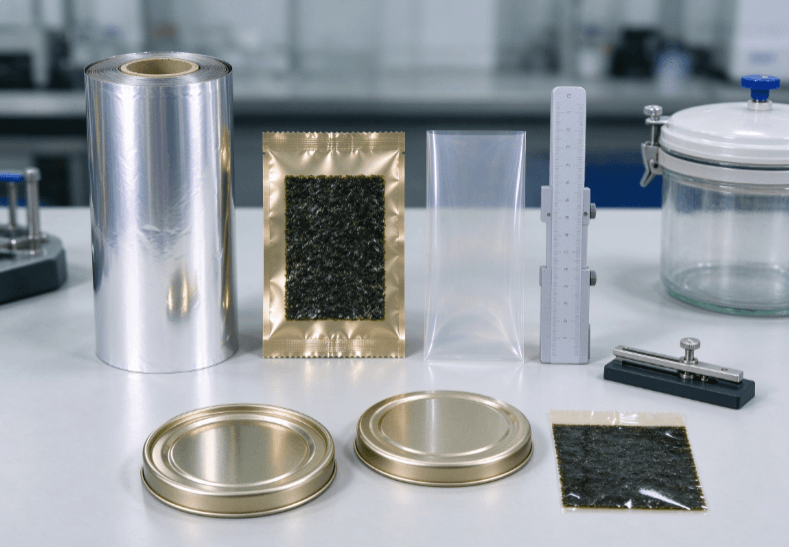
Effective seaweed snack packaging balances moisture resistance, oxygen protection, mechanical strength, and practical production requirements.
Aluminum foil laminates may suit demanding barrier applications, while metallized films and rigid containers offer alternatives for different retail formats.
The correct choice cannot be determined by appearance or material name alone.
Testing the complete packaging system with the actual seaweed product provides the strongest basis for reliable shelf-life performance.
Frequently Asked Questions
What is the best packaging material for seaweed snacks?
Aluminum foil laminates are often suitable when strong moisture, oxygen, and light barriers are required. Metallized films may also work, depending on their verified performance.
Why do seaweed snacks need moisture-proof packaging?
Roasted seaweed absorbs atmospheric moisture and can quickly lose crispness. Moisture-resistant packaging helps maintain its texture during storage and distribution.
Is nitrogen flushing necessary for seaweed snacks?
Not always. Nitrogen flushing can help reduce initial oxygen exposure, particularly in oil-seasoned products. Its value should be confirmed through product-specific testing.
Are recyclable packaging materials suitable for seaweed snacks?
They can be suitable when their barrier, sealing, and physical properties meet product requirements. Recyclability also depends on material structure and local collection systems.
What determines the shelf life of packaged seaweed snacks?
Shelf life depends on product moisture, ingredients, oxidation sensitivity, packaging integrity, and storage conditions. Manufacturers should validate shelf-life claims through appropriate testing.
Reference Sources
1. ASTM International — ASTM F1249-25
2. ASTM International — ASTM D3985-24
3. U.S. Food and Drug Administration — Water Activity (aw) in Foods
Explains the relationship between water activity and food stability.
4. U.S. Food and Drug Administration — Packaging & Food Contact Substances
Provides regulatory information on materials intended for food-contact applications.
5. U.S. Food and Drug Administration — Determining the Regulatory Status of Components of a Food Contact Material
Explains the requirements for assessing the regulatory status of food-contact materials.