

Choosing a seaweed snacks manufacturer requires more than comparing unit prices. A brand should verify food safety controls, raw-material sourcing, flavor development, packaging capability, production consistency, and export support before approving a supplier.
For private-label projects, the strongest manufacturer is not necessarily the factory offering the lowest quotation. It is the supplier that can repeatedly manufacture the approved product at commercial scale without changing taste, texture, labeling, or shelf-life performance.
Brands entering this category should first understand what seaweed snacks are and how commercial nori products are manufactured. Processing conditions directly influence crispness, flavor adhesion, moisture stability, and final retail quality.
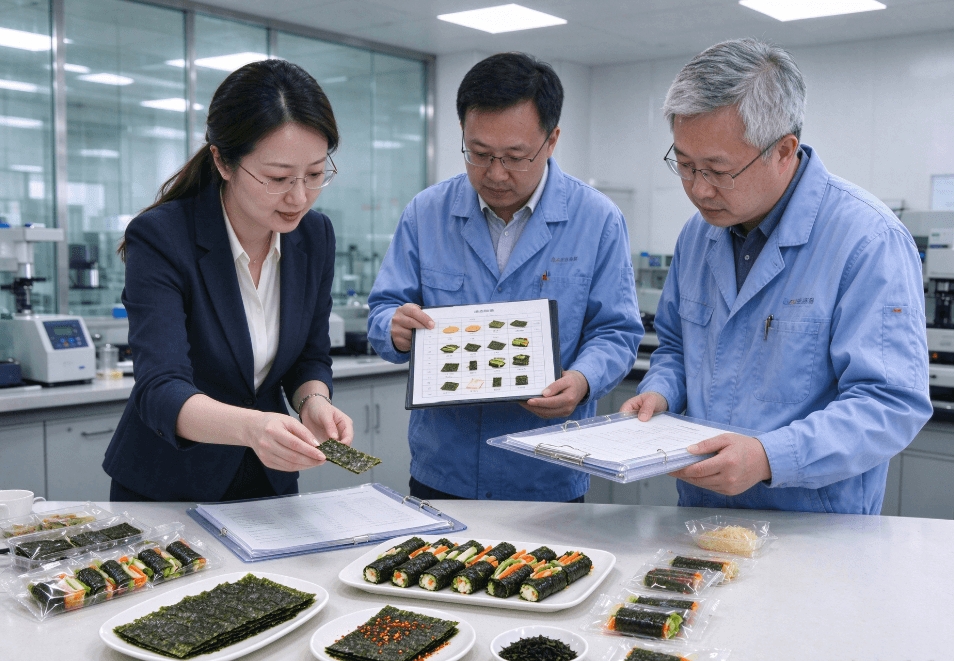
How Should You Evaluate a Seaweed Snacks Manufacturer?
Start with the manufacturing system rather than the product catalog.
Seaweed snacks are moisture-sensitive, ready-to-eat foods. Raw material handling, roasting conditions, seasoning control, foreign-material prevention, sanitation, and packaging therefore deserve close examination.
A practical supplier assessment should cover:
- raw seaweed sourcing and incoming inspection
- washing, roasting, drying, and seasoning controls
- allergen and cross-contact management
- metal or foreign-material detection procedures
- finished-product inspection
- packaging seal control
- batch identification and traceability
- laboratory testing capability
- private-label development
- export documentation
For products intended for the United States, relevant food facilities may be subject to FDA requirements under 21 CFR Part 117. These include Current Good Manufacturing Practices and, where applicable, hazard analysis and risk-based preventive controls.
Do not treat a certificate logo on a website as sufficient evidence.
Ask for the current certificate, issuing body, validity period, certified facility address, and product scope. A valid certification for another plant or unrelated production category does not automatically cover your seaweed snack project.
What to request during supplier qualification
| Area | What the Buyer Should Verify | Why It Matters |
|---|---|---|
| Raw seaweed | Origin, grade system, supplier approval | Affects color, texture, flavor, and consistency |
| Food safety | Hazard controls, sanitation, traceability | Reduces contamination and recall risk |
| Seasoning | Formula control and dosing accuracy | Prevents batch-to-batch flavor variation |
| Packaging | Film structure, sealing, moisture protection | Preserves crispness during storage |
| Testing | Microbiological and relevant chemical testing | Supports market compliance |
| OEM capability | Recipe, pack size, artwork, labeling | Determines private-label flexibility |
| Production | Commercial capacity and scheduling | Affects launch and replenishment reliability |
Documentation should support the claims made by the factory.
For example, FDA guidance expects covered facilities to conduct hazard analysis and establish preventive controls when hazards require them. Food allergen, sanitation, process, and supply-chain controls can all form part of that system.
What Food Safety Controls Matter for Seaweed Snacks?
Seaweed creates a different risk profile from conventional potato chips or grain snacks.
It originates in a marine environment, then passes through washing, forming or preparation, drying, roasting, seasoning, cutting, and packaging. The relevant hazards must therefore be evaluated through the actual manufacturing process.
A qualified supplier should understand at least four control areas.
Raw-material control
Marine ingredients can be affected by environmental conditions. Procurement teams should ask how harvesting areas, raw seaweed suppliers, and incoming batches are qualified.
Testing requirements should be based on the destination market, product type, and applicable regulations rather than a generic laboratory package.
Microbiological control
Roasting may contribute to microbial reduction, but buyers should not assume that roasting alone solves every food safety risk.
The supplier’s hazard analysis should identify relevant biological hazards and establish appropriate preventive measures.
Allergen management
Seasoned products can introduce additional ingredients such as soy, sesame, wheat-containing sauces, nuts, or other allergenic materials.
This becomes especially important when one factory runs multiple flavors on shared equipment.
FDA’s preventive-controls framework specifically addresses allergen cross-contact and correct allergen labeling for packaged foods.
Traceability
Ask the supplier to explain how a finished carton can be traced back to production records and ingredient batches.
A traceability system is more useful when the manufacturer can demonstrate the process rather than simply answering, “Yes, we have traceability.”
For U.S.-bound products, overseas manufacturers should also determine whether FDA food-facility registration requirements apply to their operation. FDA states that facilities manufacturing, processing, packing, or holding food for U.S. consumption generally must register unless an exemption applies.
Match the Manufacturer to Your Seaweed Snack Concept
Not every seaweed factory is equipped to manufacture every snack format.
A manufacturer producing sushi sheets may understand nori grading very well but lack the equipment required for complex snack formats. A heavily seasoned snack specialist may have different strengths.
Brands should define the concept before requesting a quotation.
Possible product variables include:
- roasted versus seasoned seaweed
- sheet, strip, roll, crisp, or sandwich format
- seaweed grade
- oil type
- salt level
- spicy or savory seasoning
- fruit or vegetable inclusions
- individual serving size
- multipack configuration
- retail pouch or can format
- private-label artwork
Haipu’s current range illustrates why this distinction matters. Its seaweed portfolio includes sushi nori, seasoned nori, sandwich products, shredded nori, and fruit-and-vegetable products.
Its fruit and vegetable nori range includes seaweed rolls incorporating multiple fruit and vegetable ingredients. One listed product uses banana, carrot, purple sweet potato, sweet potato, radish, okra, strawberry, and jackfruit.
This type of product requires more development work than simply changing seasoning powder.
Added ingredients can alter moisture migration, texture, binding behavior, sweetness, allergen risk, and packaging requirements. A suitable supplier should be able to explain how those variables affect production.
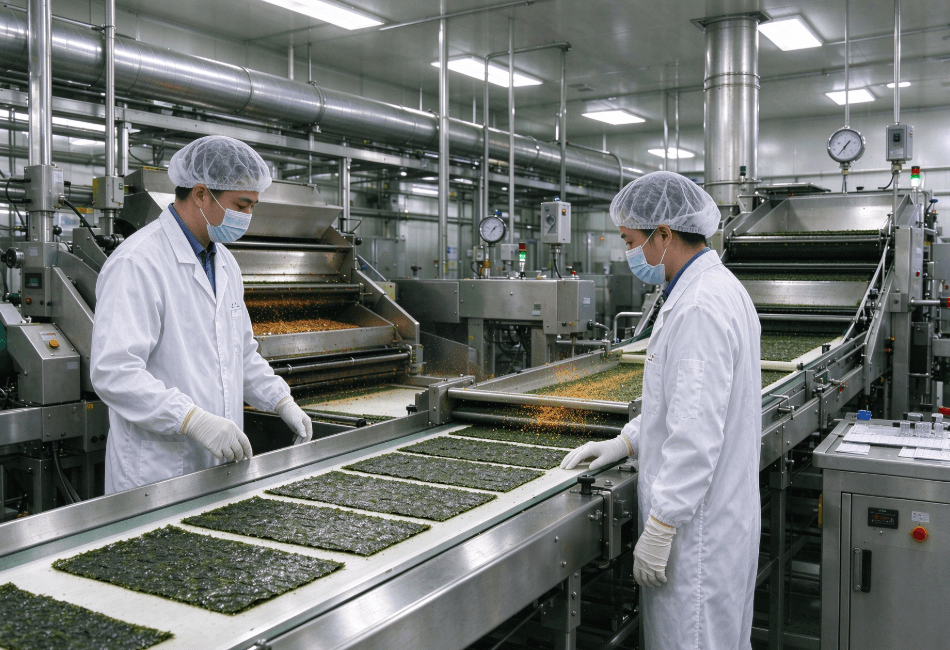
Application requirements also change the specification
A convenience-store single pack does not have the same requirements as a supermarket multipack.
An e-commerce brand may prioritize resistance to distribution damage. An importer may need multilingual labels and market-specific ingredient declarations.
Private-label buyers should therefore provide the manufacturer with the intended sales channel, target market, serving format, and positioning before approving samples.
That information gives the factory a better basis for recommending an appropriate product and package.
How to Compare OEM Seaweed Snack Manufacturers
OEM capability should mean more than placing your logo on an existing bag.
A capable OEM partner should be able to define what can actually be customized and which changes require new trials.
Typical customization may include:
| Customization Area | Questions to Ask |
|---|---|
| Seaweed | Can grade or raw-material specification be adjusted? |
| Flavor | Can salt, oil, sweetness, or seasoning be modified? |
| Format | Are custom cuts, rolls, sheets, or layered products possible? |
| Pack size | What filling or piece-count ranges are supported? |
| Packaging | Which barrier films and pack formats are available? |
| Branding | Can the factory handle private-label artwork? |
| Labeling | Can multilingual packaging be supported? |
| Cartons | Can export carton quantity and configuration change? |
Haipu states that its OEM/ODM service can cover seasoning recipes, nori grades, sheet and pack sizes, and retail-ready private-label packaging with multilingual labeling. Its website also describes product development, sampling, mass production, and export as part of that workflow.
Those capabilities should still be confirmed against the exact SKU being sourced.
A factory may support a custom package size on one production line but not another. A special seasoning may also require additional allergen controls, ingredient sourcing, or trial production.
The same principle applies to capacity.
Haipu reports a 20,000+ square-meter production base and more than 100 sets of automated equipment. These figures can indicate manufacturing scale, but buyers should still verify available capacity for their specific product and production window.
Factory size alone does not guarantee scheduling availability.
From Samples to Production: What Should Brands Verify?
A successful sample is only the beginning of supplier qualification.
The real test is whether the approved specification can be transferred into routine production.
Before issuing a purchase order, create a written product specification covering:
- seaweed type and grade
- ingredient formula
- target flavor profile
- product dimensions or piece count
- net weight
- packaging structure
- artwork version
- carton configuration
- testing requirements
- destination-market labeling requirements
Keep an approved reference sample where practical.
During commercial production, specification control becomes especially important because raw seaweed is an agricultural and marine material. Natural variation in color, thickness, and texture can occur.
The objective is not to demand impossible visual uniformity.
The objective is to agree on an acceptable specification range that protects the consumer experience.
Ask for a commercial RFQ, not only a price
A serious RFQ should include the product concept and project assumptions.
Send suppliers information about:
- destination country
- estimated order quantity
- annual volume estimate
- required pack size
- flavor requirements
- private-label requirements
- carton configuration
- testing expectations
- requested delivery terms
- target launch schedule
Then compare quotations on the same basis.
MOQ and lead time should be confirmed directly because they can change with recipe complexity, packaging inventory, printing method, production schedule, and order volume.
Avoid relying on generic MOQ figures copied from marketplace listings.
The final supplier decision should balance food safety, product fit, consistency, customization, documentation, communication, and commercial terms.
For a food brand, a slightly cheaper snack becomes expensive very quickly if weak moisture control, inconsistent seasoning, incorrect labels, or unstable production causes rejected inventory.
FAQ
What should I ask a seaweed snacks manufacturer before placing an order?
Ask about raw-material sourcing, food safety systems, testing, allergen controls, traceability, OEM options, packaging, production capacity, MOQ, lead time, and export experience.
Request supporting documents where appropriate instead of relying only on verbal confirmation.
Can a seaweed snacks manufacturer develop a custom flavor?
Many OEM manufacturers can modify seasonings, oils, salt levels, sweetness, or flavor systems.
However, a new recipe may require sampling, ingredient validation, allergen review, stability evaluation, and commercial production trials.
What is a typical MOQ for private-label seaweed snacks?
There is no universal MOQ.
It depends on the product format, packaging method, printed-film requirements, recipe complexity, and factory production conditions. Buyers should request an SKU-specific MOQ during the RFQ process.
How should I evaluate seaweed snack packaging?
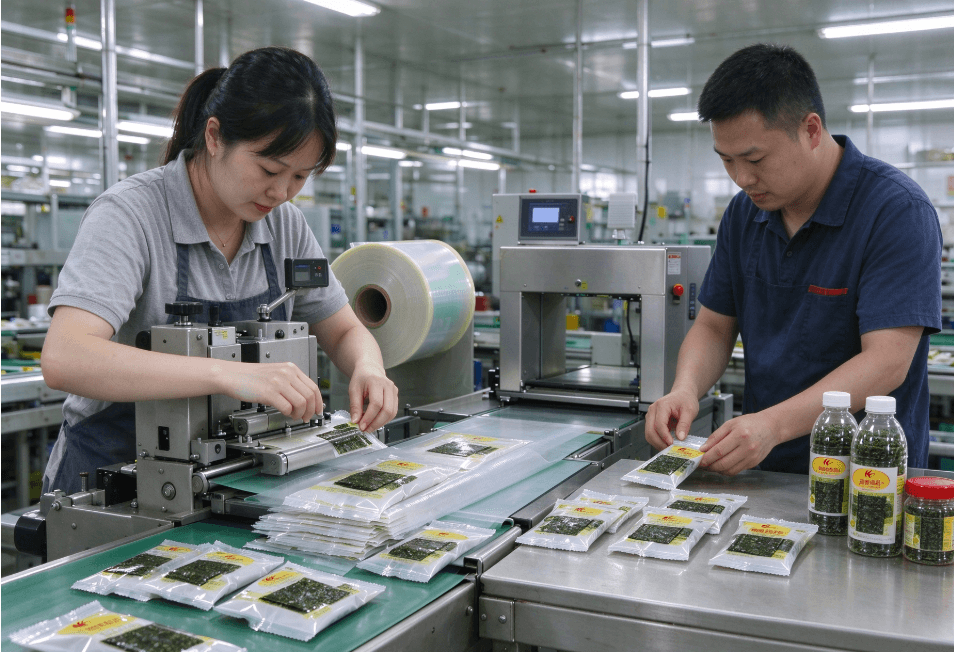
Evaluate moisture-barrier performance, seal integrity, pack format, light protection where relevant, labeling space, shipping durability, and compatibility with the intended shelf life.
Seaweed readily loses crispness when exposed to moisture, making packaging performance a product-quality issue rather than only a branding decision.
Can manufacturers produce fruit or vegetable seaweed snacks?
Some specialized manufacturers can.
These products require additional control because fruit, vegetable, seed, or other inclusions can change texture, moisture behavior, processing, and allergen considerations. Haipu currently lists fruit-and-vegetable seaweed rolls within its product range.
What information should I include in a seaweed snack RFQ?
Include the destination market, product format, flavor, pack size, estimated order quantity, expected annual volume, packaging requirements, labeling language, testing requirements, and desired delivery terms.
A detailed RFQ produces more useful supplier comparisons than asking only for “your best price.”
Reference Sources
- U.S. Food and Drug Administration — FSMA Final Rule for Preventive Controls for Human Food. Requirements and guidance concerning CGMPs, hazard analysis, preventive controls, sanitation, allergen controls, and food safety plans.
- U.S. Food and Drug Administration — Current Good Manufacturing Practices for Food. Overview of 21 CFR Part 117 and food manufacturing hygiene, sanitation, facility, equipment, and process-control requirements.
- U.S. Food and Drug Administration — How to Start a Food Business. Official guidance covering food facility registration and applicable FDA requirements.
- Lianyungang Haipu Food Co., Ltd. — Fruit & Vegetable Nori Product Category. Product examples and current fruit-and-vegetable seaweed range.
- Lianyungang Haipu Food Co., Ltd. — What Are Seaweed Snacks? Background information on nori snack formats, commercial manufacturing, seasoning, and packaging.
- Lianyungang Haipu Food Co., Ltd. — Company and Product Information. Current information on OEM/ODM capabilities, product categories, production base, and customization options.