

What does nori taste like? Nori tastes highly savory, featuring a strong umami profile with natural salinity and a subtle earthy sweetness. Unlike many marine products, premium nori does not taste heavily fishy. Instead, it delivers a clean, oceanic flavor that becomes notably roasted and nutty after the commercial baking process.
For food scientists, procurement teams, and culinary professionals, this sensory profile is highly functional. The seaweed acts as both a structural wrapping and a fundamental flavor enhancer. Sourcing the right product requires understanding exactly how this flavor is formed.
Evaluating nori involves analyzing its organoleptic properties. Food buyers look for a specific balance of taste, aroma, and mouthfeel to ensure consistent quality across large-scale manufacturing runs.
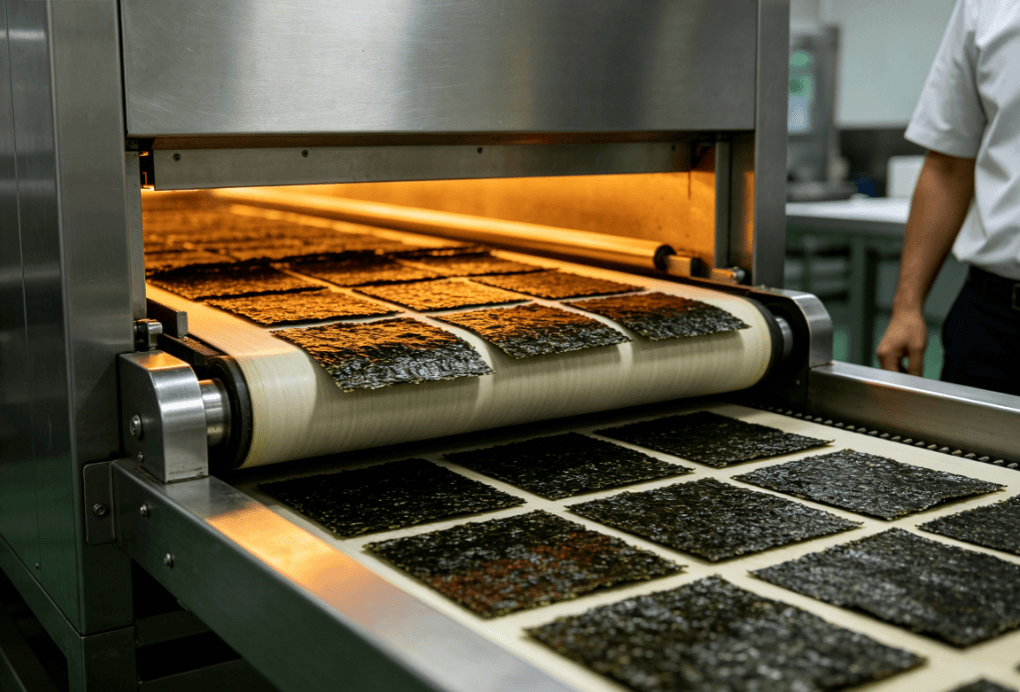
The Core Organoleptic Properties: Flavor, Aroma, and Mouthfeel
Understanding nori requires breaking down its three primary sensory components. These attributes shift depending on harvest timing and post-harvest processing.
Flavor Complexity
- Umami Intensity: This is the foundational taste. It provides a savory, mouth-coating depth similar to aged cheeses or cured meats.
- Natural Salinity: Nori retains trace marine salts. This delivers a mild, clean brine without requiring additional sodium.
- Subtle Sweetness: Early-harvest seaweeds contain higher levels of natural carbohydrates, yielding a faint sweet finish.
Aromatic Markers
High-quality roasted nori smells distinctly of toasted tea leaves and fresh sea air. It should never emit a pungent, sour, or aggressively fishy odor. Off-putting smells often indicate lipid oxidation or poor moisture control during the supply chain journey.
Texture and Mouthfeel
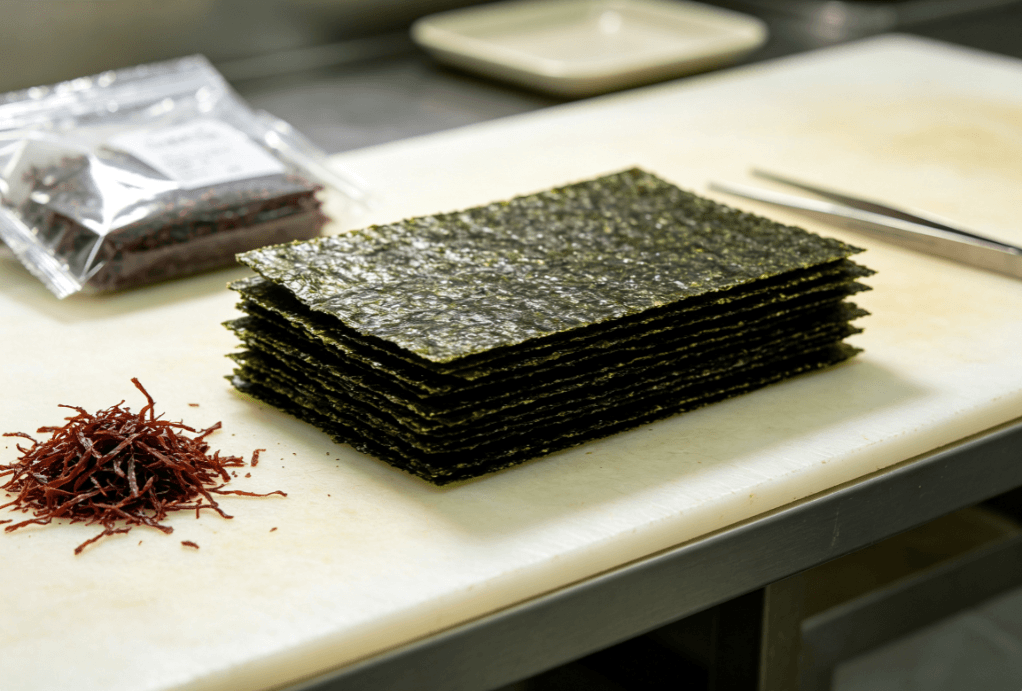
Texture is a critical quality indicator in commercial applications. A fresh sheet must be crisp and snap cleanly when folded. However, it must also melt effortlessly on the palate. If the seaweed is tough or rubbery, it disrupts the eating experience of delicate items like sushi.
The Biochemical Basis of Nori’s Umami Flavor
The intense savory flavor of nori is not coincidental. It is driven by a unique biochemical composition found in Pyropia (formerly Porphyra) red algae species.
The savory character of nori is associated with free amino acids, particularly glutamate, along with other taste-active compounds. These compounds contribute to the characteristic umami perception of edible seaweed. Their concentrations can vary according to species, cultivation conditions, harvest timing, and processing.
When these amino acids and ribonucleotides interact on the human tongue, they create a phenomenon known as umami synergy. This chemical reaction multiplies the perception of savoriness exponentially. Food formulators highly value this natural synergy, often utilizing powdered nori as a clean-label flavor enhancer in commercial snacks.
Harvest timing significantly dictates this biochemical makeup. The earliest harvests contain peak concentrations of these umami compounds. As the harvesting season extends, the amino acid profiles naturally decline, resulting in a milder flavor profile.

Thermal Processing: How Roasting Alters Taste and Texture
Freshly harvested seaweed (nama-nori) and air-dried seaweed (hoshi-nori) do not possess the signature crispness of sushi wraps. The toasted flavor and brittle texture are engineered through thermal processing to create yaki-nori.
Industrial roasting utilizes multi-zone conveyor ovens. Depending on the machine speed and factory specification, operating temperatures often range between 180°C and 300°C. The seaweed passes through this intense heat for a matter of seconds.
This rapid thermal application triggers the Maillard reaction. Amino acids and reducing sugars react to generate the toasted, nutty flavor compounds characteristic of commercial nori.
Moisture control is an equally critical manufacturing constraint. Unroasted hoshi-nori typically holds 8% to 12% moisture. Roasting significantly reduces moisture, helping produce the crisp texture expected from yaki-nori. The target moisture specification varies by product, packaging format, and shelf-life requirements. This exact target fluctuates based on the specific tensile strength and shelf-life requirements of the buyer.
Example of Commercial Nori Grade Characteristics
B2B procurement teams often rely on a grading system to match seaweed to its intended application. It is important to note that these grades are not universally standardized by law. Different manufacturers may have proprietary variations, but the following table represents typical commercial benchmarks.
| Commercial Grade | Visual Indicators | Flavor & Aroma Profile | Structural Texture | Common Industrial Application |
| Gold / A-Grade | Deep black-green, high opacity | Intense umami, sweet finish, highly aromatic. | Very delicate, crisp, melts instantly. | High-end culinary, premium sushi. |
| Silver / B-Grade | Dark green, uniform thickness | Balanced savory notes, consistent ocean aroma. | Crisp, structurally forgiving. | Automated sushi production, retail. |
| Green / C-Grade | Brighter green, occasional micro-gaps | Milder umami, straightforward marine flavor. | Slightly firmer, takes longer to melt. | Mass-market garnishes, food service. |
When selecting a grade, OEM project managers must weigh flavor intensity against structural needs. A highly delicate first-harvest sheet may taste superior but could tear during high-speed automated machine rolling.
Sourcing and Manufacturing Capabilities
Consistent flavor and texture require a highly controlled manufacturing environment. Environmental factors easily compromise the organoleptic properties of roasted seaweed.
Nori is extremely hygroscopic. If ambient humidity breaches the packaging, the seaweed rapidly reabsorbs moisture. This destroys the crisp texture and dulls the umami flavor. B2B buyers must partner with suppliers who utilize commercial-grade desiccants and hermetically sealed barrier films.
At Haipu Sushi Nori, we supply commercial yaki-nori for sushi, foodservice, and food manufacturing applications, with specifications tailored to different production requirements. By exploring their product categories, buyers can find specialized yaki-nori tailored to varying manufacturing constraints. Working with dedicated processors ensures access to precisely calibrated roasting profiles and reliable grading consistencies.
Matching the specific grade and processing method to your end product is the only way to ensure optimal flavor delivery and structural performance.
Frequently Asked Questions
Is there a difference in taste between nama-nori, hoshi-nori, and yaki-nori?
Yes. Nama-nori is freshly harvested raw seaweed with a briny, grassy flavor. Hoshi-nori is dried but unroasted, appearing dark purple-black with a chewy texture. Yaki-nori is commercially roasted, resulting in a vibrant green color, crisp texture, and nutty umami flavor.
Why does my nori taste chewy instead of crispy?
Chewy nori usually results from moisture absorption. Because the product is highly hygroscopic, leaving it exposed to ambient humidity allows the moisture content to rise above its processed threshold, immediately compromising the crisp snap.
Does nori have a strong fishy taste?
Premium commercial nori should not have an overpowering fishy taste. It features a clean, savory marine profile. An aggressively fishy or sour taste is typically a defect indicating oxidation, poor processing, or improper storage conditions.
How is the flavor profile evaluated in commercial manufacturing?
Quality control teams assess the umami intensity, absence of off-odors, surface gloss, and brittleness. Laboratory analysis may also measure the specific concentration of glutamic acid and moisture content to ensure batch-to-batch consistency.
Reference Sources
- Journal of Applied Phycology: Biochemical composition and nutritional value of Pyropia (Porphyra).
- Food Chemistry Journal: Flavor compounds and umami synergy in edible red algae.
- Codex Alimentarius (FAO/WHO): Standard for Edible Dried Seaweed (CXS 325-2017) detailing moisture thresholds and sensory defect limits.
- International Organization for Standardization (ISO): ISO 22000 can provide a framework for food-safety management, traceability, hazard control, and documented production procedures.