

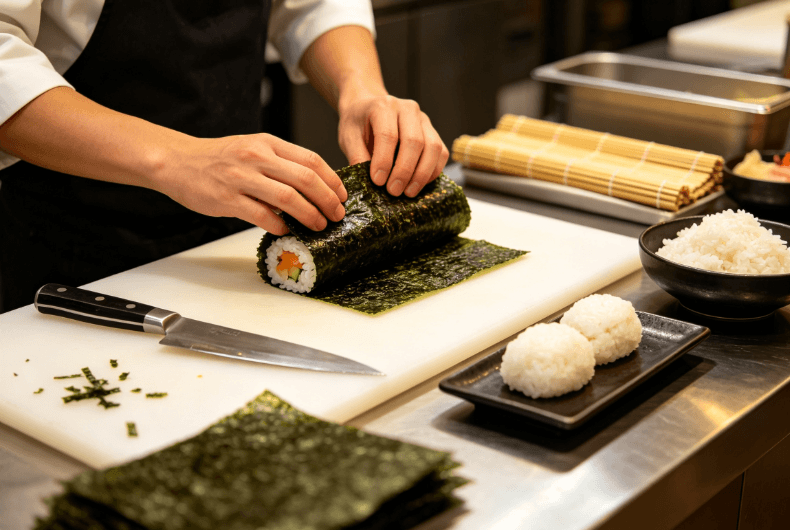
Sushi nori is an edible red marine algae processed into dried, roasted sheets. Food manufacturers use these delicate sheets primarily for rolling traditional sushi and wrapping onigiri. The raw biological material belongs to the Pyropia genus of marine algae. Industrial cultivation occurs exclusively in cold, nutrient-rich coastal waters.
Once harvested, processing facilities handle the seaweed using methods similar to paper manufacturing. The resulting agricultural product is structurally uniform, highly moisture-resistant, and rich in natural amino acids. Understanding its physical composition is critical for food service professionals and B2B procurement teams sourcing commercial sushi nori. Proper handling ensures maximum flavor retention and structural integrity during culinary application.
The Biological and Manufacturing Basics of Seaweed Sheets
Commercial sushi nori originates from highly specific strains of cultivated red algae. Aquaculture farmers cultivate these marine plants on suspended net systems in ocean environments. The organic plants require precise water temperatures and strict salinity levels for optimal growth.
In large-volume B2B production, product consistency begins at the exact moment of harvest. Raw algae strands undergo immediate chilling protocols to prevent enzymatic degradation. Manufacturing facilities then aggressively wash the raw material to remove microscopic marine debris.
Quality control engineers monitor the organic moisture content strictly throughout this early phase. Proper thermal handling ensures the final dried sheets retain their deep natural pigmentation. Any deviation in temperature can compromise the structural integrity of the final wrap.
How Are Nori Sheets Processed for Food Service?
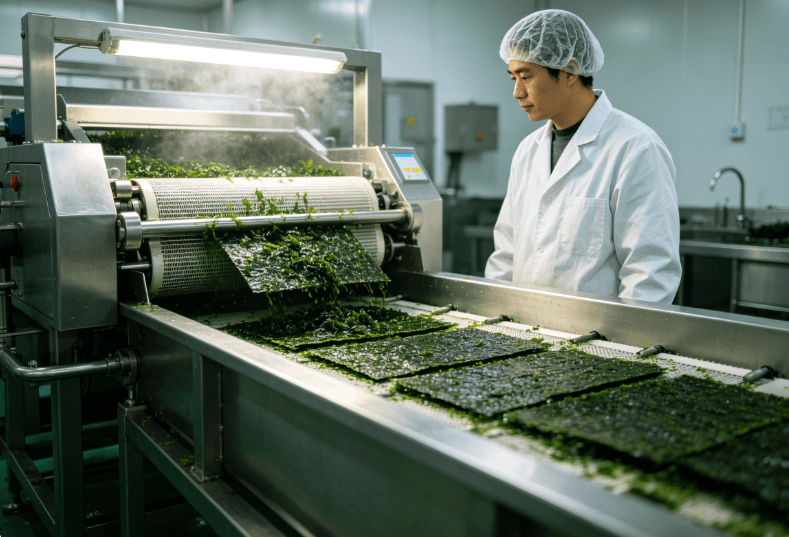
The transformation from raw marine plant to finished culinary wrapper involves highly automated workflows. Modern industrial facilities utilize specialized processing lines to achieve strict dimensional tolerances. Automated laser sensors monitor thickness consistency across the entire production belt.
Here is the standard manufacturing workflow for commercial seaweed sheets:
- Washing and Filtration: Industrial hydrostatic washers remove sand, microscopic diatoms, and foreign oceanic matter.
- Chopping and Slurrying: High-speed stainless steel blades chop the raw algae into uniform microscopic fragments.
- Sheet Formation: Precision pumps distribute the aquatic slurry onto porous, continuous moving mesh belts.
- Dehydration: Heated industrial rollers press the wet organic material into flat, continuous micro-layers.
- Precision Roasting: Secondary thermal processing exposes the dehydrated sheets to highly specific heat profiles.
Industrial roasting remains the most critical technical step in the entire workflow. The thermal process activates latent amino acids, transforming the flavor from vegetal to highly savory. Final moisture levels must drop strictly below five percent before packaging. This exceptionally low moisture threshold prevents bacterial growth and drastically extends commercial shelf life.
What Are the Quality Grades of Sushi Nori?
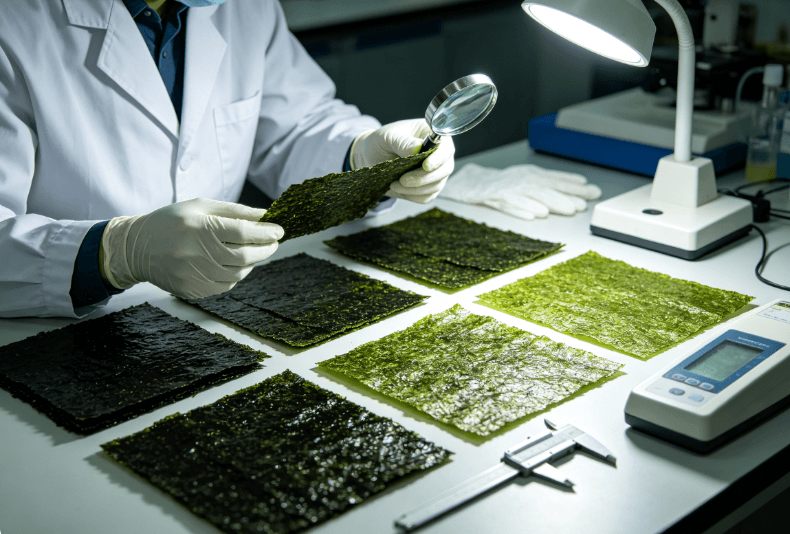
Global wholesale food markets categorize roasted seaweed sheets using a standardized color-coded grading system. Grading criteria heavily evaluate color depth, surface luster, tensile texture, and structural flaws. High-end dining environments typically require the highest visual and textural material specifications.
Below is an objective comparison of commercial seaweed manufacturing grades:
| Grade Label | Color Profile | Texture & Structure | Ideal Application |
| Gold (Grade A) | Deep black-green, high luster | Crisp, zero holes, uniform thickness | High-end sashimi, premium maki |
| Silver (Grade B) | Dark green, moderate luster | Very crisp, rare micro-holes | Standard restaurant sushi rolls |
| Green (Grade C) | Medium green, matte finish | Brittle, occasional thin spots | Buffet sushi, casual dining |
| Blue (Grade D) | Light green, dull finish | Less uniform, visible imperfections | Chopped garnishes, value snacks |
OEM project managers actively use these classifications when developing private label retail products. Selecting the correct manufacturing grade significantly impacts both unit cost and final culinary performance. A lower grade cannot withstand the moisture transfer rates required for complex restaurant dishes.
Commercial Applications: Maki, Onigiri, and Formulations
Different culinary applications require specific mechanical and physical properties from the seaweed wrapper. Maki rolls demand exceptionally high tensile strength during preparation. The algae sheet must wrap tightly around moist, acidic rice without fracturing or tearing.
Onigiri wrappers require distinct textural crispness upon immediate consumer consumption. Manufacturers intentionally package onigiri nori in specialized dual-layer thermoplastic films. This engineered packaging permanently prevents moisture transfer from the rice to the seaweed before eating.
Industrial food processors routinely utilize lower manufacturing grades for secondary consumer products. Mechanically shredded nori acts as a cost-effective topical garnish for instant noodles. Extracting the concentrated umami compounds for powdered flavorings serves as another highly viable manufacturing route.
Factory Sourcing Capabilities and OEM Packaging Context
Procurement advisors sourcing these raw materials evaluate facilities based on precise production capabilities. Experienced manufacturers like Haipu Sushi Nori manage the entire industrial processing cycle. These factories supply bulk roasted seaweed sheets directly to global importers, wholesale distributors, and private label brands.
For international distribution, strict compliance with audited food safety systems remains strictly mandatory. Authorized processing facilities typically hold verified certifications like BRCGS, ISO 22000, or FDA facility registration. OEM supply partners can easily specify exact sheet dimensions, custom cut sizes, and specialized foil packaging.
Custom packaging physically prevents ambient moisture ingress during lengthy global ocean freight shipping. Thick foil-lined barrier bags containing silica desiccants represent the baseline industry standard. Bulk commercial orders frequently require customized print designs for immediate retail-ready distribution networks.
Frequently Asked Questions
What is the standard commercial thickness of a sushi nori sheet?
Standard industrial seaweed sheets typically measure between 0.15mm and 0.25mm in total thickness. High-grade sheets maintain strict dimensional uniformity to prevent tearing during automated commercial sushi production.
How does moisture affect roasted seaweed performance?
Moisture exposure rapidly degrades the cellular structure of dried marine algae. When moisture exceeds five percent, the sheets lose their critical crispness and become unworkable. Food processors heavily rely on foil barrier packaging to block ambient humidity.
What is the functional difference between yaki nori and raw nori?
Yaki nori is the Japanese industry term for seaweed that has undergone secondary thermal roasting. Raw nori is merely dehydrated and lacks the fragile crispness required for modern sushi. Roasting activates specific amino acids that produce the signature savory umami flavor profile.
Reference Sources
- Food and Drug Administration (FDA). “FSMA Final Rule for Preventive Controls for Human Food.” U.S. Department of Health and Human Services.
- International Organization for Standardization (ISO). “ISO 22000:2018 Food safety management systems — Requirements for any organization in the food chain.”
- Global Food Safety Initiative (GFSI). “Packaging and Storage Environmental Standards for Dehydrated Aquatic Products.”
- Food and Agriculture Organization of the United Nations (FAO). “Cultivation and Processing Guidelines for Pyropia Species in Aquaculture.”