

Making sushi with nori is straightforward: place roasted nori on a bamboo mat, spread seasoned sushi rice thinly, add fillings, then roll firmly. Leave a small strip of nori uncovered at the far edge so the finished roll can seal cleanly.
The technique sounds simple, but small details determine whether the roll stays compact or falls apart. Rice temperature, moisture, filling quantity, and nori handling all matter.
Traditional rolled sushi, or makizushi, follows the same basic principle. Japan’s Ministry of Agriculture, Forestry and Fisheries describes placing roasted nori on a bamboo mat, spreading vinegared rice, adding fillings, and rolling tightly.
If you are new to nori itself, this guide to what sushi nori is and how nori sheets are used explains the material before you start rolling.
What Do You Need to Make Sushi with Nori?
You do not need restaurant equipment to make a basic sushi roll. A few well-prepared ingredients are more important than specialized tools.
For a standard maki roll, prepare:
- Roasted sushi nori sheets
- Japanese short-grain rice
- Rice vinegar
- Sugar and salt
- A bamboo sushi mat
- A sharp knife
- A bowl of water for your hands
- Prepared fillings
Beginner-friendly fillings include cucumber, avocado, cooked shrimp, crab-style seafood, omelet, and cooked salmon.
Raw seafood requires more careful food handling. The FDA notes that raw fish can carry greater parasite or bacterial risks than thoroughly cooked fish.
For first-time sushi making, cooked or vegetable fillings are easier to handle and reduce unnecessary food-safety complications.
Choose Nori That Can Hold the Roll
The nori is not simply decoration. It forms the structural outer layer of a traditional maki roll.
A useful sushi sheet should feel dry and crisp before use. It should also remain strong enough to bend around moist rice without splitting.
Haipu’s current sushi nori range includes full-size and half-sheet formats intended for sushi applications.
Full sheets are easier for larger rolls. Half sheets are useful for slimmer rolls and smaller portions.
Do not leave nori exposed on the counter longer than necessary. Dried seaweed absorbs moisture from the surrounding air and gradually loses crispness.
How to Make Sushi with Nori Step by Step
The easiest way to learn how to make sushi with nori is to control one variable at a time.
Your first goal is not restaurant-perfect appearance. It is a roll with even rice, centered fillings, and enough compression to stay together when sliced.
1. Prepare the Sushi Rice
Cook Japanese short-grain rice according to the package instructions.
Once cooked, season it with sushi vinegar while the rice is still warm. Fold the seasoning through the rice rather than crushing or aggressively stirring it.
The finished rice should be sticky enough to hold together but still show individual grains.
Japan’s MAFF recipe guidance similarly prepares vinegared rice before cooling it for rolling.
Allow the rice to cool until warm or near room temperature before putting it on the nori.
Very hot rice releases more steam and quickly softens the sheet.
2. Position the Nori on the Bamboo Mat
Place the bamboo mat on a clean, dry work surface.
Set one sheet of nori on the mat.
Most roasted nori has one smoother side and one slightly rougher side. Place the rougher side facing upward so it contacts the rice.
The smoother surface then becomes the visible outside of the finished roll.
Keep your hands and work surface reasonably dry. Water should touch your fingers when handling rice, not soak the seaweed itself.
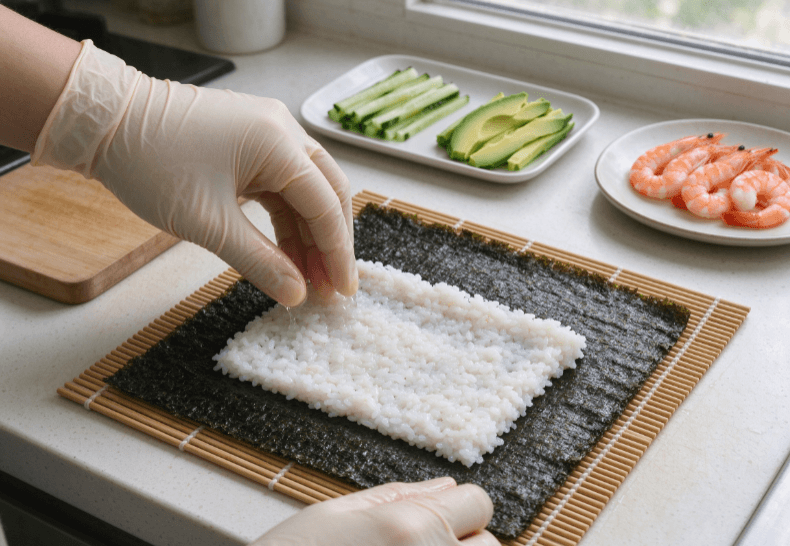
3. Spread the Rice Thinly
Wet your fingertips lightly before touching the rice.
Place rice across the nori and gently spread it toward the edges.
Do not press hard enough to mash the grains.
Leave roughly 2 cm of uncovered nori along the edge farthest from you. MAFF’s kanpyo-maki instructions use the same uncovered-edge principle.
A common beginner mistake is using too much rice.
A thick layer makes the roll oversized and difficult to close. It also overwhelms the texture of the nori and fillings.
Aim for an even, relatively thin layer.
| Element | Better Approach | Common Problem |
|---|---|---|
| Nori | Keep dry until rolling | Soft or chewy sheet |
| Sushi rice | Thin, even layer | Too much rice |
| Fillings | Narrow line near center | Overfilled roll |
| Rolling pressure | Firm and controlled | Loose or crushed roll |
| Knife | Sharp and slightly damp | Torn edges |
4. Arrange the Fillings
Place your fillings horizontally across the rice, slightly below the center.
Cut vegetables, fish, or omelet into long, narrow strips. Similar thicknesses make the roll easier to shape.
Avoid stacking several bulky ingredients.
Too many fillings create outward pressure as the roll closes. The seam may open, or the nori may split.
For a first attempt, two or three fillings are enough.
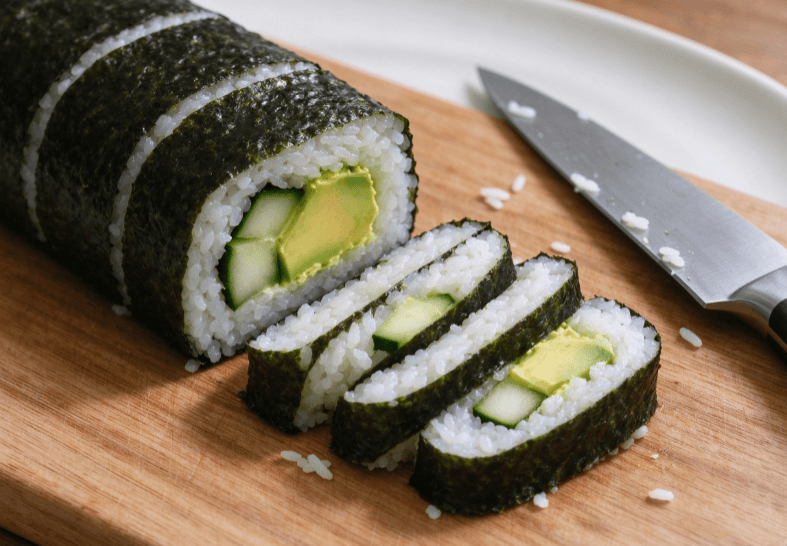
A simple cucumber-avocado roll is particularly useful for practicing technique because both ingredients can be cut into uniform strips.
5. Roll the Sushi Firmly
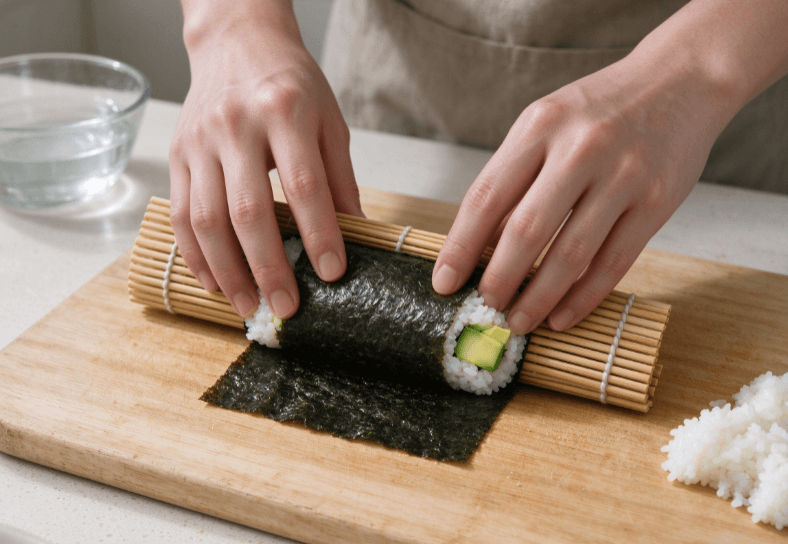
Lift the edge of the bamboo mat closest to you.
Use your fingers to keep the fillings in position while bringing the nori over them.
Once the front edge passes over the fillings, gently compress the roll through the mat.
Continue rolling forward until you reach the uncovered strip of nori.
The objective is controlled compression, not maximum force.
A loose roll separates when cut. Excessive pressure can squeeze soft fillings from the ends.
When the seam reaches the bottom, gently shape the entire roll with the bamboo mat.
You can make it round or slightly squared depending on preference.
Why Does My Sushi Roll Fall Apart?
Most failed homemade sushi rolls are caused by proportions rather than the rolling motion itself.
If the roll opens immediately, inspect the amount of rice and filling first.
Too Much Rice
Overloading the sheet with rice leaves insufficient nori to close around the roll.
Reduce the rice before trying to roll more tightly.
Too Many Fillings
A sushi roll has limited internal space.
Large avocado slices, thick cucumber pieces, and several proteins can prevent the edges from meeting.
Use narrower strips or fewer ingredients.
Wet Nori
Nori begins losing its crisp structure after prolonged contact with moisture.
Prepare your fillings before opening the nori package.
This allows you to assemble the roll without leaving sheets exposed unnecessarily.
Uneven Rolling Pressure
Pressing only in the center creates loose ends.
Apply even pressure across the full width of the bamboo mat.
You should feel the ingredients settle into one compact core.
How to Cut Nori Sushi Rolls Without Tearing Them
Rolling is only half the process. Poor cutting can damage an otherwise good sushi roll.
Use a sharp chef’s knife or sushi knife.
Lightly dampen the blade before cutting. This reduces rice sticking to the metal.
Do not saw aggressively through the roll.
Use a clean slicing motion and wipe the blade when starch begins building up.
For a standard roll, first cut it in half. Place the two halves together, then divide them into equal pieces.
MAFF’s futomaki guidance similarly describes rolling the ingredients with a bamboo roller before cutting the finished roll into portions.
Serve the sushi soon after cutting.
Leaving completed rolls for long periods allows moisture from the rice to migrate into the nori, producing a softer texture.
Nori Outside vs Rice Outside: What Changes?
Traditional maki usually places the nori on the outside.
Uramaki, often called an inside-out roll, places the rice on the outside and the nori around the fillings.
| Roll Style | Outside Layer | Difficulty | Best For |
|---|---|---|---|
| Maki | Nori | Easy | Beginners |
| Hosomaki | Nori | Easy | One or two fillings |
| Futomaki | Nori | Medium | Multiple fillings |
| Uramaki | Rice | Medium | California-style rolls |
| Temaki | Nori cone | Easy | Hand rolls |
For beginners, nori-outside maki is usually easier.
The seaweed acts as a visible wrapper, making it easier to judge whether the seam closes correctly.
Inside-out rolls require an additional step because the rice contacts the mat. Many cooks cover the bamboo mat with food-safe wrap before making this style.
Simple Sushi Roll Example for Beginners
A cucumber and avocado maki provides an easy starting point.
Prepare:
- 1 sheet roasted sushi nori
- Cooked and seasoned sushi rice
- 2–3 cucumber strips
- 2–3 avocado strips
Place the nori on your bamboo mat and spread rice evenly across it.
Leave approximately 2 cm uncovered along the far edge.
Arrange cucumber and avocado horizontally.
Lift the front of the mat, roll the nori over the fillings, and gently tighten the cylinder.
Continue forward until the seam closes underneath.
Allow the roll to rest briefly with the seam down before slicing.
Once this technique becomes consistent, you can add tamagoyaki, cooked seafood, pickled vegetables, or other sushi fillings.
The same rolling fundamentals remain unchanged.
FAQ
Which side of nori goes down when making sushi?
For standard maki, place the smoother side of the nori against the bamboo mat. The slightly rougher side faces upward and holds the rice.
Should sushi rice be hot or cold before putting it on nori?
Use warm or room-temperature sushi rice rather than steaming-hot rice. Excess steam can soften the nori before you finish rolling.
How much rice should I put on one nori sheet?
Use enough rice to create a thin, even layer without completely burying the seaweed. Excess rice is one of the main causes of oversized rolls.
Do I need a bamboo mat to make sushi with nori?
No, but a bamboo mat makes even compression much easier. A clean piece of food-safe wrap can assist when a mat is unavailable.
Why does my nori become chewy after making sushi?
Nori absorbs moisture from rice and the surrounding air. Assemble rolls close to serving time and keep unused sheets sealed until needed.
Reference Sources
- Ministry of Agriculture, Forestry and Fisheries of Japan (MAFF) — Kanpyo-maki, traditional rolled sushi preparation.
- Ministry of Agriculture, Forestry and Fisheries of Japan (MAFF) — Futomaki preparation using rice, nori, fillings, bamboo rolling, and slicing.
- U.S. Food and Drug Administration (FDA) — Food-safety information concerning raw fish and sushi.
- Haipu Food — What Is Sushi Nori? A Guide to Nori Sheets for Sushi.
- Haipu Food — Sushi Nori product category and available sheet formats.