

Directly Answering Your Commercial Sourcing Requirements
Successfully buying sushi nori wholesale requires matching manufacturing grades to your specific automated assembly limits. Procurement teams must mandate dual-layer aluminum moisture barrier packaging to survive ocean freight. Buyers must also align their RFQs with standard 100-carton or 20ft container minimum order quantities (MOQ). Sourcing stable wholesale supply chains ultimately means auditing factory roasting tolerances to prevent structural brittleness during transit.
Evaluating marine agricultural products requires strict attention to material stability. Seaweed sheets are highly susceptible to ambient humidity and rapid structural degradation. Factory selection directly dictates product performance on your high-speed food assembly lines.
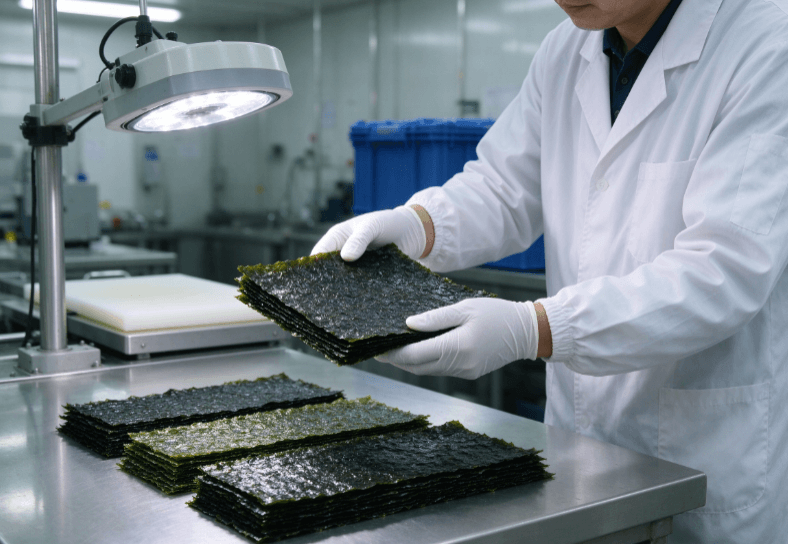
Matching Raw Material Grades to Commercial Automation Limits
Commercial wholesale markets utilize a strict color-coded grading framework. This system categorizes both structural tensile strength and visual quality. Sourcing the correct manufacturing grade prevents catastrophic production waste on robotic assembly lines. A wrap lacking adequate flexibility will immediately fracture when exposed to acidic rice.
Engineers designing automated food workflows typically mandate Gold or Silver grades. These tiers guarantee continuous line operation without jamming.
| Grade Tier | Visual Profile | Structural Integrity | Target Commercial Application |
| Gold (A) | Deep black-green luster | Zero micro-holes, max tensile strength | Premium automated maki lines |
| Silver (B) | Dark green, crisp finish | Highly uniform thickness parameters | Standard restaurant sushi rolls |
| Green (C) | Medium green, matte | Occasional thin spots, slight brittleness | Buffet dining, casual food service |
| Blue (D) | Light green, dull finish | Visible imperfections, low strength | Shredded garnishes, flavor extraction |
Matching the raw material grade to your final product margin ensures financial efficiency. Value-grade sheets are often mechanically shredded into cost-effective garnishes for instant noodles. Procurement teams must define this end-use application during the initial consultation.
How Precision Thermal Roasting Impacts Tensile Strength
Roasted seaweed (Pyropia species) undergoes rigorous thermal processing before entering commercial distribution. Material consistency begins at the exact moment of aquatic extraction. Raw algae strands are washed, chopped into uniform slurries, and pressed into micro-layers.
The most critical manufacturing phase is secondary thermal roasting. This precision process drops the organic moisture content strictly below five percent. Such an exceptionally low moisture threshold halts bacterial proliferation. It also drastically extends the commercial shelf life necessary for global logistics.
If a supplier fails to control these thermal profiles, the finished wrapper becomes highly brittle. Insufficient roasting also fails to activate the latent amino acids driving savory flavor profiles. Factory auditors must verify that processing facilities employ automated laser sensors to monitor temperatures continuously.

Engineering Moisture-Proof Packaging for Ocean Freight
Moisture ingress during global transit remains the absolute highest supply chain risk factor. Standard corrugated cardboard cartons are entirely insufficient for cross-border ocean logistics. Ambient oceanic humidity will quickly penetrate standard plastic films.
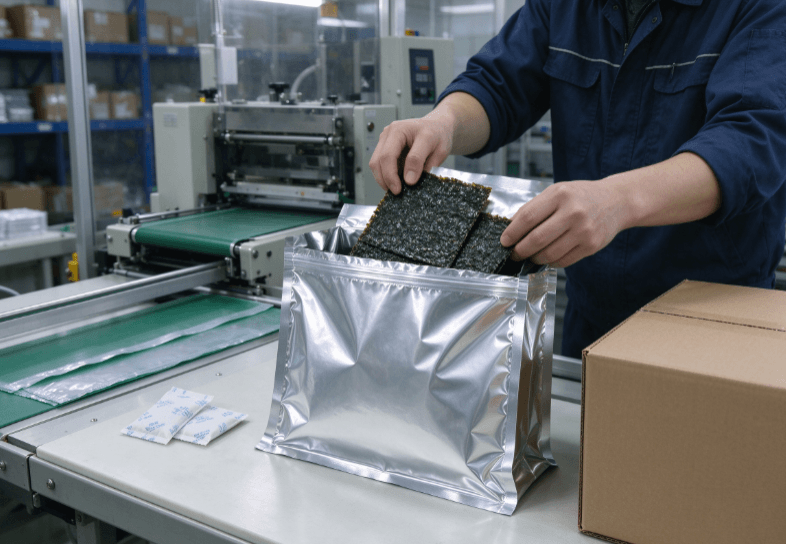
Industrial packaging engineers combat this using specialized dual-layer thermoplastic films. Factories must insert commercial-grade silica desiccants into every sealed barrier bag. This absorbs internal humidity trapped during the factory sealing process.
For standard bulk transit, interior aluminum foil liners are non-negotiable. Procurement contracts should explicitly state the required bursting strength of the exterior master cartons. Weak outer packaging leads to compression damage, crushing the fragile sheets inside.
Executing Your RFQ: MOQ, Lead Times, and Custom Specs
Executing a reliable cross-border transaction requires a highly structured RFQ workflow. When finalizing supply contracts for sushi nori wholesale, B2B buyers must audit the exact processing capabilities. Facilities managing everything from initial aquaculture harvesting to final commercial packaging offer superior quality control.
Standard commercial order logic requires validating specific manufacturing parameters:
- Volume Thresholds: Base minimums usually start at 100 cartons for standard specs.
- Dimension Tolerances: Submitting exact millimeter sizing for specialized processing machinery.
- Barrier Specs: Confirming the integration of aluminum liners and active desiccants.
- Compliance Data: Validating active BRCGS, ISO 22000, or FDA facility registration.
For private label distribution, procurement teams frequently require fully customized retail print designs. Custom printing cylinders usually push the minimum order requirement to a full 20ft container.
Consolidating your printing and processing with a single OEM partner drastically reduces total lead times. For sourcing managers drafting initial specifications, reviewing a comprehensive guide to nori sheets helps clarify exact material expectations. Establish these baselines early to avoid communication errors during mass production.
Frequently Asked Questions
What drives minimum order quantities for private label packaging?
Custom foil printing requires dedicated copper manufacturing cylinders for each color layer. Factories typically require a 20ft container order to absorb these upfront tooling costs. Standard unprinted bulk cartons offer much lower entry thresholds, often starting at just 100 cases.
How do winter harvest seasons affect processing lead times?
Raw Pyropia availability fluctuates globally between November and April. During peak winter harvests, processing lines operate continuously, dropping standard lead times to roughly 15-20 days. Off-season wholesale orders may face slight delays as facilities extract raw materials from deep cold storage.
Can OEM facilities cut custom sheet dimensions for machinery?
Advanced processing facilities utilize programmable laser cutters to execute highly specific dimensions. Buyers must submit exact millimeter tolerances during the RFQ stage. Precise sizing prevents catastrophic jamming incidents on high-speed robotic assembly equipment.
Which compliance certifications should international suppliers provide?
Professional sourcing teams must mandate verified ISO 22000, HACCP, or BRCGS safety certifications. Facilities exporting commercial food products to the United States must maintain active FDA registration. These documents prove strict adherence to global preventive contamination controls.
Reference Sources
- International Organization for Standardization (ISO). “ISO 22000:2018 Food safety management systems — Requirements for any organization in the food chain.”
- Food and Drug Administration (FDA). “FSMA Final Rule for Preventive Controls for Human Food.” U.S. Department of Health and Human Services.
- Global Food Safety Initiative (GFSI). “Packaging and Storage Environmental Standards for Dehydrated Aquatic Products.”
- Food and Agriculture Organization of the United Nations (FAO). “Cultivation and Processing Guidelines for Pyropia Species in Aquaculture.”