

Choosing a kids seaweed snack manufacturer requires more than comparing unit prices. Private label buyers should first verify children’s nutrition standards, product development capability, export certifications, packaging performance, MOQ flexibility, and batch traceability. A factory that meets these criteria can reduce launch risk while supporting consistent quality across different markets.
1. What Should a Kids Seaweed Snack Manufacturer Offer in Its Formulation?
A children’s product should begin with a controlled formulation, not a cartoon package. Buyers should ask how the factory manages sodium, oil, seasoning, allergens, additives, and serving size.
Low-sodium and clean-label formulation
Many parents look for snacks with a short ingredient list. A suitable formulation may use seaweed, vegetable ingredients, natural seasonings, and carefully controlled oil and salt levels.
A qualified kids seaweed snack manufacturer should explain each ingredient’s function and provide specifications, allergen information, nutrition data, and laboratory results.
Key points to review include:
•Low-sodium seasoning options for children’s age-specific products.
•No unnecessary preservatives or artificial colours where the target market permits.
•Natural fruit or vegetable juice and powder options.
•Clear allergen controls for sesame, soy, wheat, and other ingredients.
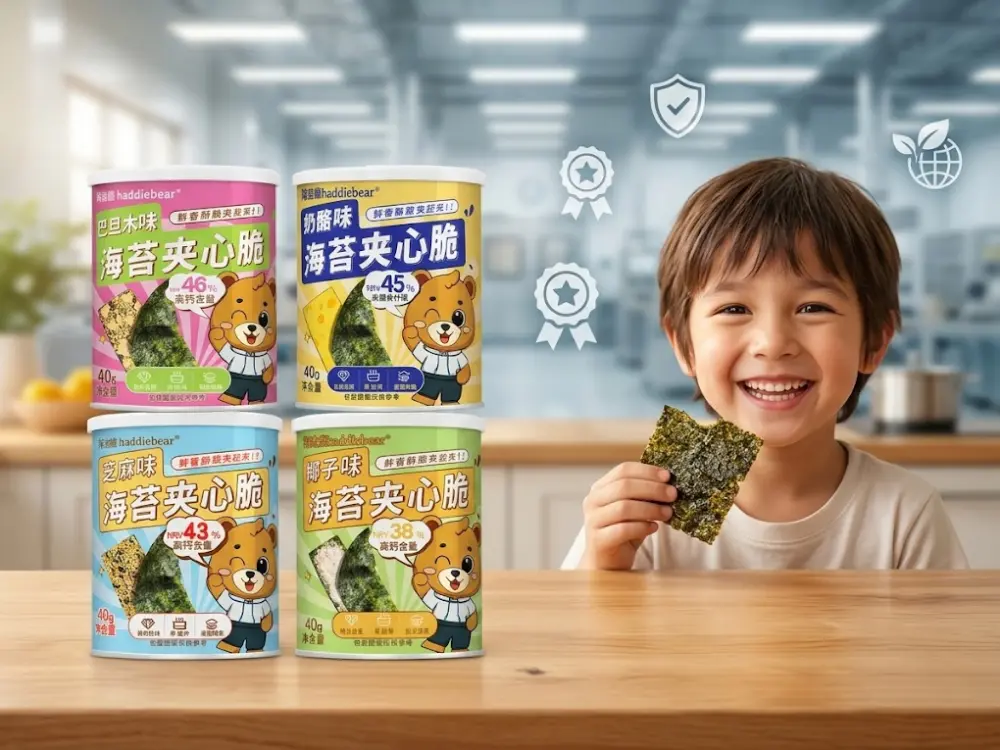
Fruit and vegetable ingredients can add colour and flavour without relying entirely on artificial additives. Haipu Food’s fruit and vegetable nori range, including the HaddieBear seaweed roll concept, supports this type of differentiation.
The final formula requires market-specific review because sodium limits, permitted additives, nutrition claims, and labelling rules differ by country.
2. R&D and Product Formats: Can the Factory Develop for Children?
Product format influences safety, handling, portion control, and repeat purchase. A kids seaweed snack manufacturer should offer more than one standard roasted seaweed sheet.
For younger consumers, the product should be easy to open, hold, chew, and portion. The appropriate format depends on the intended age, texture, serving size, and local retail channel.
Potential formats include:
•Small individually wrapped seaweed sheets for lunch boxes.
•Seaweed rolls with fruit or vegetable ingredients.
•Filled or layered seaweed crisps for a stronger snack experience.
Before commercial production, the factory should conduct laboratory trials covering formula, texture, seasoning, packaging, and stability.
Request a documented sample process covering revision rounds, lead time, testing scope, and approval points. Microbiological testing is essential before a kitchen sample becomes a production trial.
A strong R&D team also understands manufacturing constraints. A seasoning may distribute unevenly on an automated line, while a roll may crack if moisture, tension, or filling ratios are not controlled.
3. Kids Seaweed Snack Manufacturer Evaluation Checklist
Capacity and certification determine whether a supplier can support a stable international launch.
During an audit, review production, sanitation, calibration, training, and corrective-action records. Confirm that certificates cover the relevant facility and product scope.
| Evaluation Criteria | Standard to Look For | Haipu Food Capability | Buyer Benefit |
| Nutritional formulation | Low-sodium options, controlled oil, clean-label development, allergen documentation | Fruit and vegetable nori and children’s snack development support | A clearer route to market-specific positioning |
| Product development | Lab trials, sample revisions, texture and format innovation | Kids seaweed snacks, sandwich nori, rolls, and fruit and vegetable formats | More options for differentiated private label products |
| Manufacturing capacity | Stable automated lines, documented sanitation, scalable output | More than 20,000 m² of production space and 100+ automated machines | Better continuity during commercial scale-up |
| Quality systems | HACCP, ISO9001, batch records, testing procedures | HACCP and ISO9001 systems, with SGS-related testing support | Stronger export and retailer compliance evidence |
| Market access | Halal and export registration where required | Halal and Export Food Manufacturer Registration | Easier preparation for international channels |
| Packaging performance | Moisture barrier, sealing control, nitrogen filling, print accuracy | Custom packaging coordination for seaweed snack formats | Better crispness, shelf stability, and shelf appeal |
| Traceability | Raw material, production, and finished-goods batch tracking | Batch-based production and quality documentation | Faster investigation and controlled recalls |
Lianyungang Haipu Food Co., Ltd. operates an integrated seaweed manufacturing base in Lianyungang. Its stated capabilities include more than 20,000 square metres and 100 automated machines, with Fruit & Vegetable Nori, Kids Seaweed Snacks, Sandwich Nori, and Seaweed Rolls in its portfolio.
The company also operates the Puno Tai and HaddieBear brands, supported by ISO9001, HACCP, Halal, SGS, and Export Food Manufacturer Registration credentials.
Certificates are starting evidence, not a substitute for due diligence. Check validity, scope, issuing body, audit date, and named production site.
4. How Do Packaging and MOQ Affect a Private Label Launch?
Packaging protects the product and communicates the brand promise. For seaweed snacks, moisture control is critical because humidity can reduce crispness and shorten the consumer’s acceptable shelf life.
A suitable kids seaweed snack manufacturer should discuss the following packaging details:
•Aluminium-foil or equivalent high-barrier structures.
•Heat-seal width, seal integrity, and leak testing.
•Nitrogen flushing to reduce oxygen exposure where appropriate.
•Child-friendly graphics without making unsupported nutrition claims.
•Production and batch coding.
Children’s packaging should be attractive while keeping safety information readable and claims compliant with destination-market rules.
MOQ is equally important. Large MOQs can create inventory pressure for new brands, while very small MOQs may increase unit cost or limit packaging options. Ask whether the factory offers different MOQs for stock packaging, custom printed film, and fully customized formulations.
A practical commercial discussion should cover artwork approval, packaging lead time, sample fees, production MOQ, and reorder MOQ. The best kids seaweed snack manufacturer explains these trade-offs before quotation.
5. Traceability, Hygiene, and Food Safety Controls
Seaweed products require disciplined control from incoming materials to finished-goods release. Buyers should understand how each lot connects to production records.
A complete traceability system should link:
•Raw seaweed or nori sheet lot numbers.
•Seasonings, oils, fruit, and vegetable ingredient batches.
•Packaging film and carton batch numbers.
•Final release records and shipment information.
Hygiene controls should include zoning, personnel flow, pest control, cleaning validation, foreign-material prevention, and environmental monitoring. Moisture management is also a quality priority.
Depending on the recipe and packaging system, the finished product may target a moisture range of approximately 3–5%. The actual limit should be product-specific and confirmed through shelf-life testing, not copied from a generic specification.
Nitrogen filling can help reduce oxygen exposure inside sealed packs. It does not replace good sanitation, validated sealing, correct storage, or microbiological testing. A professional kids seaweed snack manufacturer should explain how these controls work together.
Before approval, private label buyers should complete these checks:
1.Review the factory’s food-safety plan and critical control points.
2.Request recent product specifications and representative test reports.
3.Verify sample packaging for seal quality, coding, and moisture protection.
4.Conduct a pilot production run using the intended formula and packaging.
5.Arrange independent inspection or third-party testing when required by the buyer or destination market.
6.Approve a golden sample and written product standard before mass production.
FAQ for Private Label Kids Seaweed Snacks
What is the typical MOQ for kids seaweed snack OEM production?
MOQ depends on formula, format, printed packaging, and production line. Stock packaging usually allows greater flexibility than custom film. Request separate sample, pilot, commercial, and reorder quantities.
How long does formula customization usually take?
A simple seasoning adjustment may require fewer revisions than a new fruit and vegetable seaweed roll. Allow time for trials, testing, packaging validation, and approval.
Can the factory make samples before a purchase order?
OEM projects often begin with paid laboratory or pilot samples. Confirm sample rounds, courier costs, and whether the approved sample becomes the production reference.
Should buyers arrange third-party inspection?
Third-party inspection can support new suppliers, high-value shipments, or retailer programs. It should complement, not replace, HACCP controls and internal testing.
Industry Quality and Compliance Standards Cited
•HACCP: Hazard analysis and preventive control of biological, chemical, and physical food-safety risks.
•ISO9001: Quality-management principles supporting documented processes and continual improvement.
•FDA requirements: Relevant U.S. food, ingredient, labelling, facility, and importer obligations, depending on the product and transaction.
•Halal: Religious and supply-chain requirements for markets and consumers requiring Halal compliance.
•SGS testing or inspection: Independent verification services that may support product testing, inspection, or compliance documentation.
•Export Food Manufacturer Registration: Registration evidence required for applicable export manufacturing activities.
For private label brands, the right kids seaweed snack manufacturer connects formulation, product development, packaging, production, and traceability into one controlled process. Lianyungang Haipu Food Co., Ltd. offers a relevant platform for fruit and vegetable nori, children’s formats, and export-oriented OEM support. Buyers should still complete document review, sample approval, factory audit, and destination-market compliance checks before signing a production agreement.